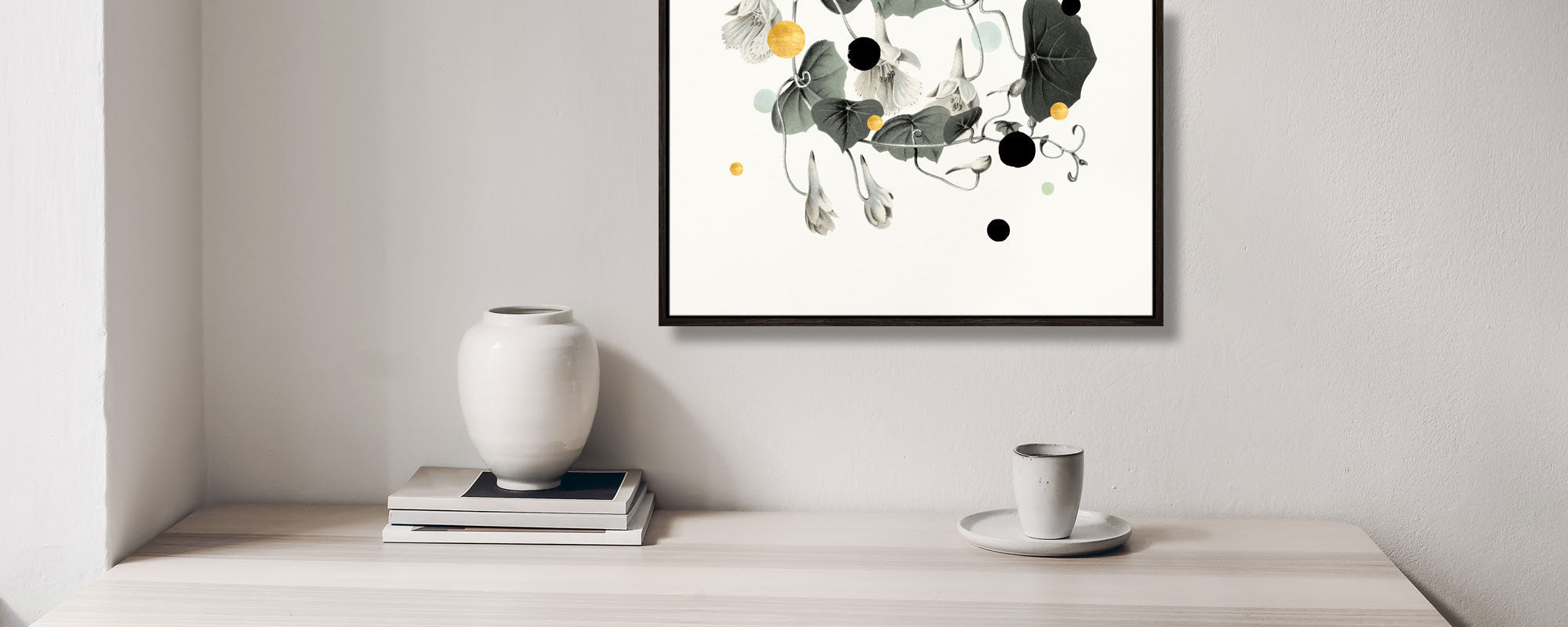
Best art prints for the living room: how to choose
The living room reveals more about your taste than almost any other room. It is where the eye rests, conversations arise, and the home's atmosphere becomes evident. Therefore, choosing the best art prints for the living room is not about filling an empty wall, but about creating a visual rhythm that feels both personal and precise.
A well-chosen print can unite a room, soften a stark interior, or add character to an otherwise understated environment. But it requires a more conscious approach than simply choosing a motif that "matches the sofa." Art in the living room must be able to withstand both distance and proximity. It must work in daylight, in evening light, and in the lived-in space.
What makes an art print a good choice for the living room?
The best art prints for the living room first and foremost have presence. They can be graphic and stringent, poetic and organic, or more tactile in their expression, but they should have a quality that holds the gaze a little longer. In a living room where one spends many hours, superficial motifs quickly become flat.
The good choice arises in the tension between motif, scale, and materiality. A strong motif alone is not enough if the format is too small for the wall, or if the paper does not give the motif the depth it deserves. Conversely, a simple work can gain great strength when printed with precision on exclusive paper, where nuances, contrast, and texture clearly emerge.
Therefore, you should view the art print as a whole. The composition, color saturation, the character of the paper, and the framing work together. This is precisely where the difference between wall decor and curated art becomes noticeable.
The best art prints for the living room depend on the room's character
There is no single correct choice, only the right choice for the specific living room. A high-ceilinged apartment with stucco and daylight calls for something different than a modern townhouse with clean lines and subdued materials. When choosing art prints, you should therefore start with the room rather than with the artwork alone.
If the living room has a calm, monochrome expression, a print with deeper contrasts or more prominent color fields can create tension without disturbing. If the room is already rich in textures, furniture, and objects, a simpler and more refined motif will often provide the necessary balance. Art does not have to compete with the interior. It should elevate it.
The same applies to the function of the walls. A large wall behind the sofa can carry a dominant work with volume and visual authority. A narrower wall, a corner with an armchair, or the area near a bookshelf is often better suited for a smaller format or a tighter composition. Scale is not just a practical question. It shapes the experience of tranquility.
When large prints are the right choice
Large art prints add weight to the living room. They create an anchor point and can make the room feel more cohesive. Especially in homes with space around the furniture or a few, well-chosen elements, a larger work acts as a quiet but clear signature.
The advantage of large formats is that the motif has room to unfold. Brushstrokes, collage areas, archival details, or graphic transitions become more tangible when they are not compressed into too small a section. The disadvantage is that a large work places higher demands on both the quality of the motif and the proportions of the room. If the composition is restless, it becomes even more restless on a large scale.
When a gallery wall makes more sense
A gallery wall can be an obvious choice if you want a more personal and cohesive atmosphere. Here you can work with variation in format, motif type, and framing, but only if there is still a curated thought behind it. The most beautiful gallery wall does not feel random. It feels composed.
In the living room, a gallery wall works particularly well when you want to create intimacy around a specific area, for example, above a sideboard or along a dining area in open connection with the living room. However, it requires more discipline than many imagine. Too many small works without internal calm can make the wall visually noisy.
Motifs that suit a living room
Abstract art prints are often a safe and sophisticated choice for the living room. Not because they are neutral, but because they allow for interpretation. They can be more mood-setting than narrative and therefore fit well in rooms where one spends time both alone and with others.
Photo-based works, collages, and archival motifs can add another kind of depth. They often carry a layer of memory, culture, or visual transformation, which makes them interesting over time. Here, it is crucial that the work does not become too illustrative. The living room benefits from motifs with openness rather than motifs that explain themselves immediately.
Botanical forms, landscape hints, and poetic compositions work well in many homes, precisely because they create tranquility without becoming anonymous. More graphic or urban motifs, on the other hand, can provide the right tension in a minimalist interior. It depends on whether you want the living room to whisper or make a statement.
Materials and print quality matter more than most people think
If you want to invest in the best art prints for the living room, you should look closely at the production. A motif can be beautiful on screen, but without the right printing technique and the right paper, it loses depth, nuance, and presence.
Giclée prints are among the most convincing choices when quality is paramount. The technique provides high color precision and a tonality that suits both complex shadows and fine transitions. On exclusive art paper, the work gains a tactility that ordinary posters rarely approach.
Canvas can be the right choice if you want more volume and a more painterly appearance. But it depends on the motif. Some works benefit from the sharpness and matte elegance of paper, while others gain more character on canvas. Hand-finished details, such as gold leaf or individual finish layers, add an extra dimension. They make the work less reproducible in experience and more present in the room.
This is also where limited editions differ from mass production. Numbering and signature not only change the collector's value of the work. They emphasize that the print is part of a conscious artistic process and not just a decorative reproduction.
Colors, light, and framing
The choice of colors should be based on the living room, but not be bound by it. Art that matches too precisely can quickly become too neat. The more interesting choice often lies in a related tone or a controlled contrast.
If your living room is kept in warm neutral shades, dusty blues, deep green tones, or earthy reddish fields can create resonance. If the room is cooler and more architectural, softer sand colors, black-and-white contrasts, or subdued organic tones can provide balance. Light plays a role. A print that seems understated in daylight can take on a much darker character in the evening.
Framing is not an afterthought. It determines how the work meets the wall. A slender oak frame adds warmth and tactility. A black frame creates graphic stringency. A white frame can add lightness, but only if the work itself has enough weight. A passepartout adds air and calm, especially around smaller or more detailed motifs.
How to choose with more confidence
If you are in doubt between several works, don't first ask which one is the prettiest. Ask which one has the longest resonance. The art print you keep coming back to is often the right one.
Also consider how you use your living room. Is it a representative space with many guests, or a sensory sanctuary where you seek peace? A high-contrast work with striking energy can be excellent in a social setting, but less ideal in a room where you want to unwind in the evening.
It can also be worthwhile to work with mockups, paper silhouettes on the wall, or a simple measurement before deciding on the format. Many choose too small. Premium art deserves space. It should be felt.
At StoltzeStudio, this curated approach is not a detail, but the very starting point – to choose works where motif, material, and finish are conceived as one complete experience.
The best art in the living room is rarely the loudest. It is the one that continues to give the room character, even when the rest of the decor changes.