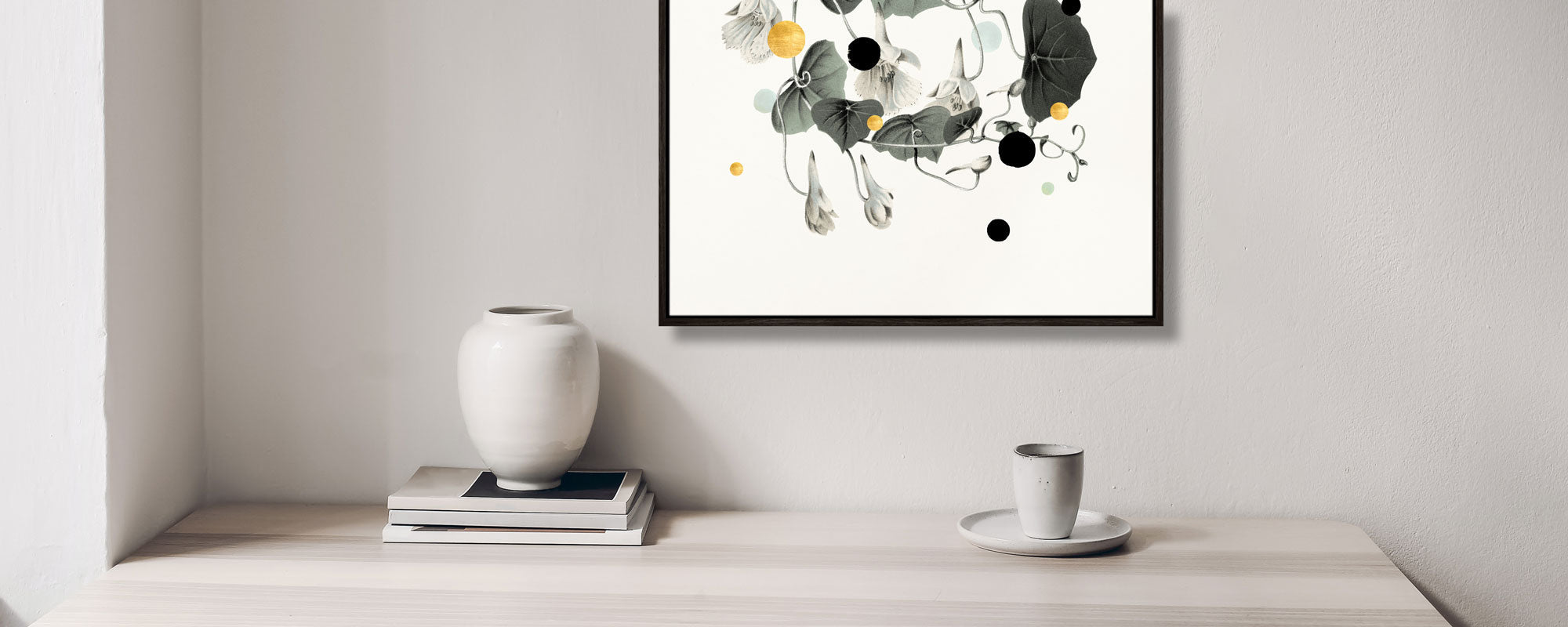
Canvas or art paper - what should you choose?
A motif can completely change its character depending on what it is printed on. This is precisely why the question of canvas or fine art paper is not a technical detail, but an aesthetic choice with great significance for the work's presence, depth, and the atmosphere in the room.
When you have a motif that is meant to live on a wall for many years, it's rarely enough to ask what looks pretty. The more interesting question is how the surface interacts with light, colors, and the desired tempo in the interior design. A print shouldn't just fit the wall. It should capture the gaze.
Canvas or Fine Art Paper - The Difference is Felt
Canvas and fine art paper speak two different aesthetic languages. Not in quality, but in expression. Both can be exclusive choices when production is uncompromising, but they give the artwork different types of presence.
Canvas has a tactile surface with a soft, painterly character. The texture slightly breaks the light and can give the motif a more tactile and atmospheric appearance. This makes canvas particularly strong when you want calm, volume, and a more organic expression. Colors can appear rich and warm, but also a little more subdued than on smooth or finely textured fine art paper.
Fine art paper, on the other hand, is the material of precision. Here, details are sharper, contrasts clearer, and nuances often gain a more refined vibrancy. An exclusive Giclée print on acid-free fine art paper can reproduce subtle shifts in shadows, skin tones, collage surfaces, and photographic archival traces with great depth. Where canvas invites distance and a sense of the whole, fine art paper often invites close study.
This does not mean that one is better than the other. It means that the material should be chosen based on the character of the work - and the mood you want to create.
Which Motifs Best Suit Canvas?
Canvas works particularly well for motifs that can have a sensory weight. Abstractions, poetic compositions, color fields, landscape moods, and works with painterly movement often achieve a convincing tranquility on canvas. The surface adds a discreet tactility that can unify the motif and make it less analytical in its expression.
It is also a material that can be ideal for larger formats. A large canvas piece can stand with an almost architectural calm, especially in rooms where a less reflective surface is desired. In living rooms, bedrooms, and hospitality environments with soft textiles, wood, stone, and muted palettes, canvas can help create a more cohesive and understated space.
There is a trade-off, however. If the motif is built around very fine lines, sharp typographical elements, or microscopic detail shifts, the texture of the canvas can slightly diminish the precision. This is not necessarily a loss - but it is a shift. The work becomes more atmospheric and less clinically sharp.
When Canvas Makes the Most Sense in Interior Design
Canvas is often the right choice when the art should be experienced as an integral part of the room's materiality. If you want a wall with calm rather than high contrast, or if the work should interact with a curated interior without becoming too harsh in its outline, canvas has a particular strength.
This is especially true in homes where art should not only decorate but also create a sensory sanctuary. Here, the surface becomes part of the experience.
When is Fine Art Paper the Strongest Choice?
Fine art paper elevates motifs where detail, tonality, and the elegance of the surface are crucial. Photographic works, collages, graphic compositions, and motifs with fine transitions between light and shadow often benefit from the precision of paper. Here, the layers of the image become more legible, and the work's intention stands out more clearly.
Fine art paper comes in several qualities and textures, but common to the best papers is that they provide sophisticated depth without appearing glossy or commercial. Good fine art paper absorbs and carries the pigment calmly. The result is a print with great color fidelity, beautiful nuance control, and a surface that feels like a conscious choice - not just a substrate.
For many design-conscious collectors, fine art paper is also closer to the classic gallery experience. Especially when the work is framed with care, a sharpness and stillness emerge that suit both modern and more eclectic environments. This is particularly true in rooms where art is meant to be viewed closely, or where the work is part of a more curated gallery wall.
Fine Art Paper and the Importance of Framing
Paper rarely lives alone. The frame, mat, and glass become an active part of the overall expression. This is an advantage if you want a more defined and architectural look, but it also places greater demands on the overall presentation.
A work on fine art paper can appear almost museum-like with the right framing. Conversely, a less thoughtfully chosen frame can weaken even a strong motif. The choice of material does not stop at the paper. It continues in the presentation.
Light, Finish, and Placement Alter the Choice
Many choose between canvas or fine art paper based on taste alone, but the lighting conditions in the room play an equally important role. If you have a room with strong daylight, changing sunlight, or many light sources, the way the surface receives light will significantly affect the experience.
Canvas often has an advantage in rooms where you want to avoid too much reflection. Its matte tactility makes the artwork more stable throughout the day. Fine art paper, on the other hand, can be exceptionally beautiful in controlled light, where the fine details and the depth of the pigments truly come into their own. Here, it's not about good or bad, but about the type of experience you want when you pass the artwork morning, afternoon, and evening.
Placement also matters. In a narrow room, an entryway, or a work area where you often get close to the artwork, fine art paper will often reward the short distance. In larger living spaces, where the work is viewed more holistically, canvas may be more natural.
What Does the Material Signal?
Materials communicate. Not loudly, but precisely. Canvas often signals something more tactile, artistic, and informally monumental. Fine art paper signals precision, curation, and a more pronounced graphic or photographic awareness.
This is worth taking seriously, especially if the work is to hang in a room that also represents you professionally. In a private home, canvas can create a warm, relaxed luxury. In an office, showroom, or meeting room, fine art paper can provide a sharper cultural authority. But here too, there are nuances. A handcrafted paper work with gold leaf or a numbered edition can have a physical aura that challenges the idea of paper as the more restrained choice.
The best question, therefore, is not what looks most expensive. It is what feels most authentic to the work and the room.
How to Choose Between Canvas or Fine Art Paper
Start with the motif. Is it a work that thrives on structure, movement, and atmosphere, or on detail, layers, and precision? Then look at the room. Is the ambition soft tranquility or sharp definition? And finally, consider distance. Should the work be experienced up close or across a room?
If you are in doubt, it is often because both materials can work - but in different ways. In these cases, it is wise to choose based on the emotional effect rather than the technical one. Canvas often makes a work more sensory and spacious. Fine art paper makes it more focused and refined.
At an atelier-based art house like StoltzeStudio, it is precisely this type of choice that is treated as part of the work's curation, not as an afterthought. The material is not packaging around the motif. It is a co-creator of the experience.
Some works benefit from having an edge, others from having stillness. When you choose with an eye for surface, light, and atmosphere, the art doesn't just fit in. It begins to set the tone in the room.