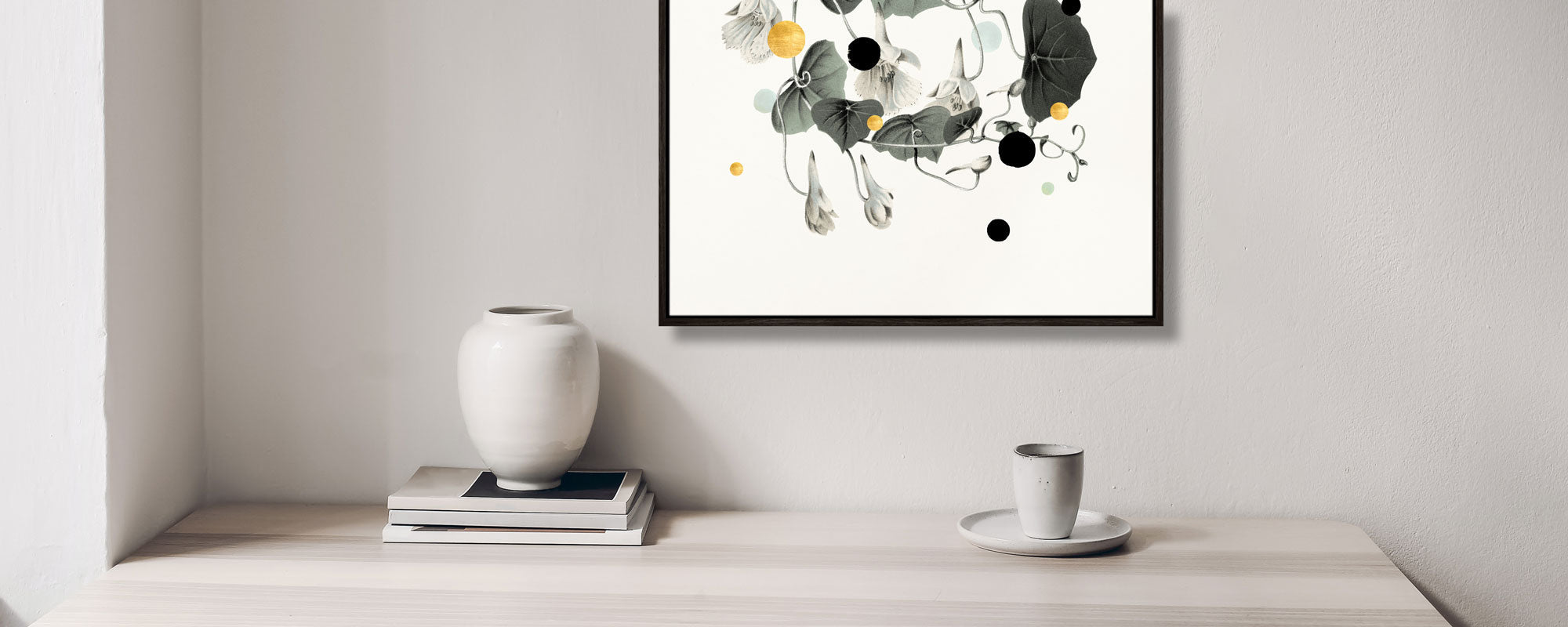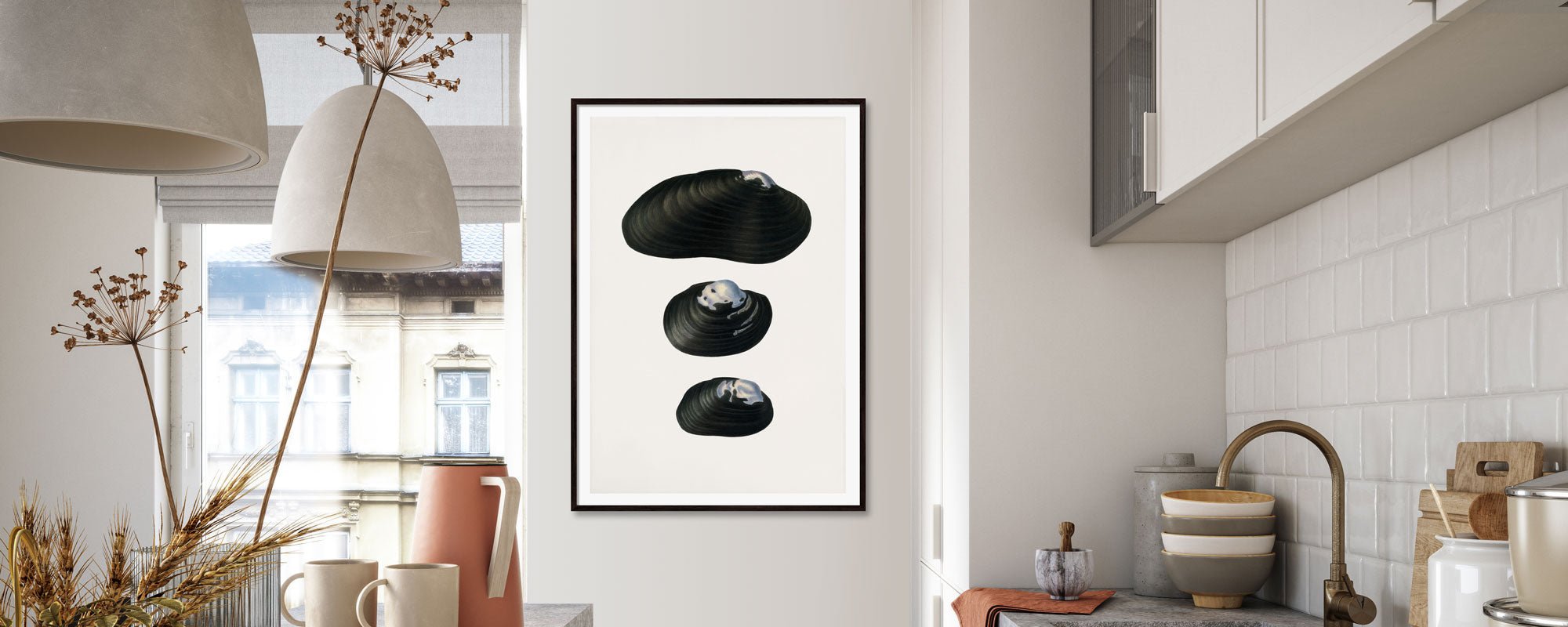
Organic art for the home
A room reveals itself in its lines. Sharp, architectural choices can provide precision and discipline, but it is often the softer movements that make a home feel alive. Organic artworks for the home add precisely that quality – a more sensory rhythm, where shapes, surfaces, and colors work with the space instead of merely filling a wall.
The organic is not a trend in the superficial sense. It is a way of looking at composition, balance, and materiality. When a work draws on nature's curves, imperfect structures, earthy nuances, or fluid transitions, a different kind of presence emerges. The wall becomes less stark. The decor less predictable. The overall impression more cultivated.
What characterizes organic artworks for the home?
Organic works are rarely bound to one specific style. They can be abstract, botanically inspired, collage-based, or almost sculptural in their imagery. The common denominator is a sense of movement and naturalness. The form should feel intuitive. The color field should have texture. The composition should live with small shifts, layers, and tensions.
This is precisely where the quality reveals itself. An organic work functions best when it doesn't become decorative in a superficial way. There must be enough resistance to make the eye linger. A curve alone does not make a work interesting. It is the interplay of rhythm, proportion, color depth, and the way light meets the material.
In a premium home, it is often this type of art that creates calm without becoming anonymous. It speaks softly, but with authority. It invites contemplation rather than attention-seeking.
Why organic works so powerfully in modern interiors
Many modern homes are built around clean surfaces, fixed axes, and carefully selected materials such as stone, wood, steel, and glass. This provides clarity but can also make a room feel cold if nothing breaks the discipline. Here, organic works serve as a visual counterbalance.
A large print with fluid forms can soften a kitchen-diner with many hard lines. A poetic composition in muted earthy tones can unify a bedroom where textiles and furniture might otherwise stand as individual pieces. In an entryway, a smaller work with textured layers and natural movements can create a more generous arrival.
It's not about making the home rustic or nature-romantic. Quite the opposite. Organic works can be extremely sophisticated. When well-curated, they emphasize the refined side of a room and add a warmth that strict minimalism often lacks.
Colors, shapes, and the right temperature in the room
When choosing art for the home, color temperature is crucial. Organic works function particularly strongly when they either extend the room's existing palette or add a subtle shift. Sand, umber, chalk, deep green, smoky blue, and warm grays create a calm base. More saturated hues can be used but require greater precision.
The same applies to form. Soft contours, asymmetrical movements, and layered surfaces can provide lightness, but if everything in the work is too fluid, it loses tension. A good organic work often has an anchor – a darker mass, a distinct edge, a stylized surface, or a striking contrast that holds the composition together.
Therefore, one should always consider what the room is lacking, rather than simply what one immediately finds aesthetically pleasing. Does the room lack weight, air, warmth, or rhythm? The choice of art becomes more precise when it answers that question.
When a large work is the right choice
In spacious living rooms, above sofas, or in open dining areas, a larger organic work can create the calm that several small pictures cannot always achieve. A single large format gives the eye a cohesive experience. It feels less fragmented and more architecturally secure.
However, this requires the work to have enough depth to support its size. Fine art prints with nuanced color buildup, exclusive paper or canvas, and possibly hand-finished details have a presence that makes the format credible. Without that material quality, a large work can quickly feel flat.
When smaller works create more intimacy
In bedrooms, home offices, or narrow passages, smaller formats can be more effective. Here, one gets closer to the work, and the intimate scale allows for details, texture, and subtle transitions.
A smaller organic work can serve as a quiet focal point – not as a statement, but as an atmosphere. It is often here that more poetic compositions come into their own.
Materials matter more than many think
A motif can be beautiful digitally, but it is only in the material that the work acquires its true character. Paper type, pigmentation, surface, and framing not only change the appearance but the entire experience of the work in the room.
Giclée prints on exclusive paper typically provide refined color depth and a soft, almost velvety rendering of nuances. Canvas can add more body and a slightly painterly weight. Hand-finished details, such as gold leaf or other tactile finishes, add light and unpredictability – especially in rooms where daylight changes throughout the day.
For organic works, this is particularly important because they thrive on tactility. If the surface becomes too smooth or the reproduction too harsh, the work loses some of its sensory integrity. In a home where one has invested in materials with character, the art should meet the same standard.
How to precisely place organic artworks
Placement is not just about wall space. It is about sightlines, distance, and the way the work integrates into the room's tempo. An organic work should have space around it. Not necessarily a lot of space, but enough for the form to breathe.
Above a sofa or sideboard, it often works best when the artwork follows the width of the furniture with a certain margin. If hung too small, it loses authority. If hung too high, it loses its relation to the decor. In more intimate rooms, a lower hanging can provide a more contemplative experience.
One should also consider the light. Organic compositions with fine tonal differences deserve lighting conditions where the nuances are not washed out. Direct, harsh sunlight can be problematic for some materials, while soft side light often highlights surface and depth more beautifully.
Curation over clutter
The biggest mistake is rarely choosing the wrong work. It is choosing too many. When organic works are used as mere decoration, they lose the tension that otherwise makes them strong. A home with aesthetic integrity does not need walls that are fully covered. It needs works that are chosen with an eye for space, mood, and longevity.
Therefore, curation is more important than variety for variety's sake. A single work on the right scale can elevate a room more than an entire gallery wall without direction. If working with multiple pieces, there should be a clear relation in tone, material, or compositional energy.
For collectors and design-conscious buyers, limited editions often carry extra weight. Not only because the print run is limited, but because the edition logic supports the experience of the work as something chosen, not mass-produced. This fits naturally with homes where originality is valued higher than rapid replacement.
A more personal home without it becoming private in a closed-off way
There is a difference between personality and overexposure. Organic artworks make it possible to imbue a room with character without making it anecdotal or over-interpreted. They create atmosphere, but still leave the room open. This is an essential quality in private homes, creative workspaces, and hospitality environments alike.
This is precisely why many choose this type of art when they want a home that feels thoroughly crafted rather than staged. The organic allows for stillness, tactility, and contemplation. It is not art that shouts. It is art that remains interesting.
At StoltzeStudio, this approach is closely linked to the idea of art as a sensory sanctuary – an encounter between poetic compositions, uncompromising material quality, and a curated calm that can be felt in the room long after the first glance.
If you stand before an empty wall, do not just choose by color and dimensions. Choose by the atmosphere you wish to live in. The right work does not just change the wall. It changes the way the room holds you.