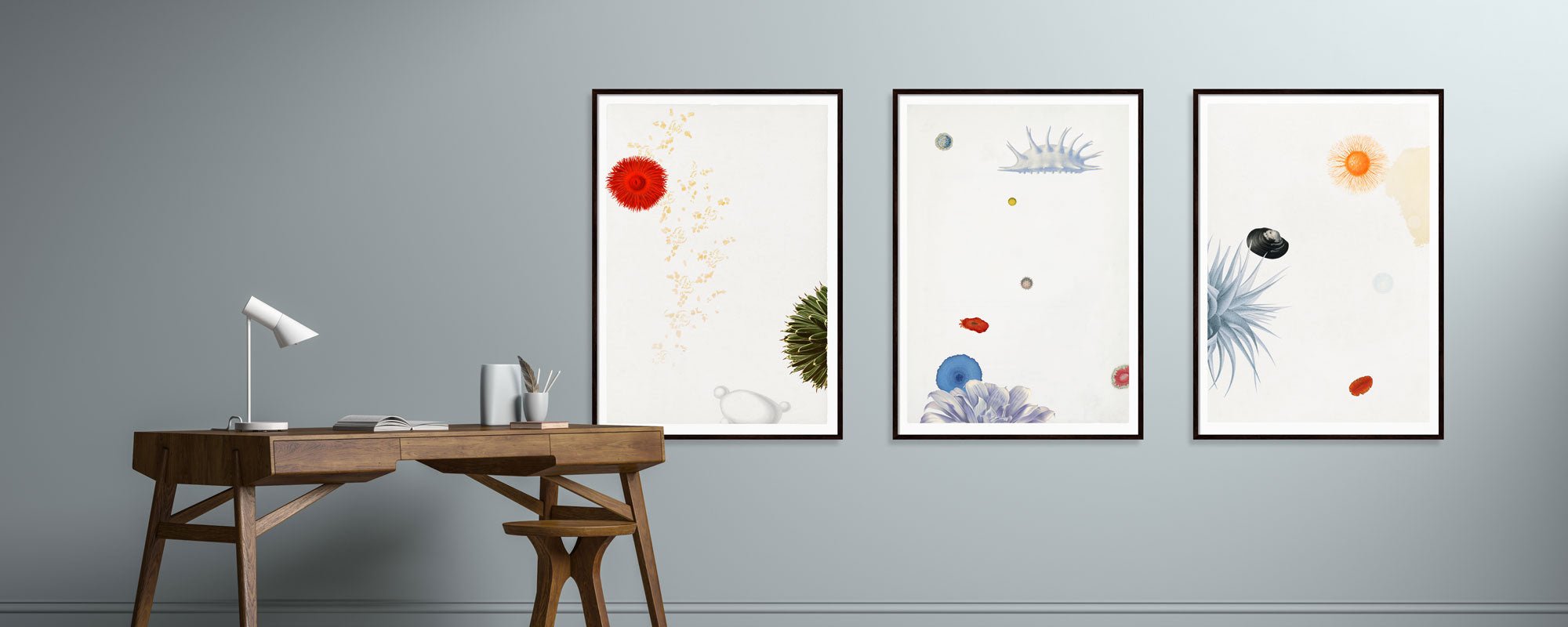
Article: High-quality Giclée art print
High-quality Giclée art print
An image can look beautiful on a screen and still lose its impact as soon as it's printed on paper. This is precisely where the difference lies. When you talk about high-quality giclée art prints, you're not just talking about decoration; you're talking about translating a work's essence, depth, and texture into a physical format that can captivate the eye for years.
In a market full of quick prints and standard decorative solutions, giclée has become a benchmark for those who want more than just a motif on the wall. Not because the word itself is exclusive, but because the process behind it can be. When executed with uncompromising precision, it offers a level of detail and sensory richness that ordinary reproductions rarely come close to.
What does high-quality giclée art print mean?
Giclée is a printing method where pigment-based inks are applied to fine art paper or canvas with very high resolution and great color accuracy. But the technique alone doesn't make a print excellent. A high-quality giclée art print only comes into being when several elements work together – the original file or scan, the printer's calibration, the quality of the ink, the character of the paper, and the final inspection.
It is therefore misleading to believe that all giclée prints are the same. Two works can be produced using the same overall method and still feel vastly different. One may appear flat, harsh, and mechanical. The other possesses tranquility, depth, and a presence that makes colors, shadows, and textures come alive with an almost painterly sensitivity.
For the design-conscious buyer, quality is not just about technical specifications. It's about whether the work maintains its expression in daylight, in varying rooms, and over time. It's also about whether the material feels like an integrated part of the work rather than a neutral surface.
Why the material matters as much as the motif
The paper is not merely a carrier of the motif. It is a co-interpreter. A matte cotton paper can give a work a quiet, almost velvety depth, where nuances unfold with elegance. A more textured paper can support collage, graphic transitions, or archival motifs with greater tangibility. On canvas, a different kind of weight emerges – often more corporeal, more spatial, and in some cases closer to the feel of an original painting.
Here lies one of the crucial differences between premium prints and mass-produced wall art. When paper choice and motif speak the same language, the result is compelling. When they don't, even a strong motif can lose its authority.
The same applies to the ink. Pigment-based ink is chosen not only for color saturation but for stability and durability. It gives the print better resistance to fading and preserves the work's tonality more faithfully over time. For collectors, interior professionals, and quality-conscious home buyers, this is no small detail. It is the very difference between a short-term purchase and a work you want to live with.
Color Depth, Tonality, and Quiet Luxury
A well-produced giclée print rarely announces itself loudly. Its quality often lies in what doesn't seem forced. Transitions in shadows are soft. Dark areas don't collapse. Light surfaces don't lose their airiness. Skin tones, dusty shades, deep blues, and complex earth tones are given space to breathe.
It is precisely this quiet luxury that many seek in an art print. Not gloss for gloss's sake, but an experience of visual tranquility. A print should be able to withstand both a quick glance from a distance and a slow, close examination. One should be able to see that the work is produced with precision, but without the process stealing attention from the motif.
For works with fine lines, layered compositions, or poetic color gradients, giclée is often the obvious choice. The technique can capture delicate details that might otherwise be lost in cheaper printing methods. However, an important caveat applies here too – the more subtle the motif, the more revealing any production error becomes.
High-quality giclée art prints require curation
Perhaps the most overlooked aspect of high-quality giclée art prints is not the print itself, but the curation behind it. Which works are suitable for reproduction? Which formats maintain balance? Which surfaces support the work's character without diluting it?
There are motifs that work best as unique originals, and others that gain a new, compelling life as fine art prints. This assessment requires both technical knowledge and artistic judgment. Without it, the result easily becomes decorative in the wrong sense – pretty, but without resonance.
This is also where limited editions become significant. Not just as a marketing ploy, but as a way to protect the work's integrity. Numbering, signature, and a conscious edition logic signal that the work is intended as a collector's item and not merely an infinite reproduction. For many buyers, this is a vital part of the experience.
In atelier-based environments like StoltzeStudio, this curation becomes particularly evident because the print is not treated as a secondary product. It is seen as an extension of the artistic process, where paper, format, surface, and any handcrafted details are part of the work's final identity.
When is giclée the right choice?
If you're looking for a work with greater visual depth than a standard poster, giclée is often the obvious place to start. This is especially true in homes, offices, and hospitality environments where wall art needs to contribute more than just color coordination. It needs to create atmosphere, substance, and personality.
Giclée is particularly suitable when the motif contains complex textures, photographic nuances, painterly transitions, or collage-based layers. The technique is also relevant if you want larger formats without losing resolution and finesse. A large-scale work places higher demands on production because any weakness becomes visible in the room.
However, there are situations where a simpler print may suffice. If the purpose is purely temporary, or if budget is the absolute priority, giclée is not necessarily the most rational solution. Premium print is a choice for those who value materiality, durability, and the slow satisfaction of good craftsmanship.
How to assess quality in practice
When you're looking at a print, words like "museum quality" or "fine art" rarely tell the whole truth. Instead, look for concrete signs. How do the dark tones work? Are the details intact without appearing sharply digital? Does the paper have character? Does the surface feel intentionally chosen?
Also, ask about pigment inks, paper type, and edition information. If this information is unclear or superficial, it's often a sign that the quality lies primarily in the narrative and not in the production. A serious art print withstands transparency.
The physical experience is crucial. A good giclée print has a weight that you both see and feel. Not necessarily literally in grams alone, but in the way the work holds the room. It feels finished. Calm. Convincing.
The framing, of course, also plays a role. Even the finest print can lose its precision in weak framing or behind ordinary reflective glass. Conversely, a well-chosen frame and correct mounting can elevate the work further and give the motif the architectural finish it deserves.
More than printing – a way to collect
For many, giclée becomes the entry point to buying art with greater awareness. Not as a compromise, but as a format. It provides access to curated works with high material quality, often in limited editions, without having to move directly into the market for original masterpieces.
This also makes giclée interesting for experienced buyers. A limited edition print with a signature, specific paper choice, and any handcrafted details can have a unique presence of its own. Some works even benefit from reproduction because the format, surface, and precise printing process emphasize the composition's particular rhythm.
Therefore, the question should not only be whether a print is original or reproduced. The more interesting question is whether the work has been created and produced with enough integrity to earn its place. When the answer is yes, you don't just get something beautiful on the wall. You get a work that creates a sensory breathing space in the room and continues to give back long after it has been hung.