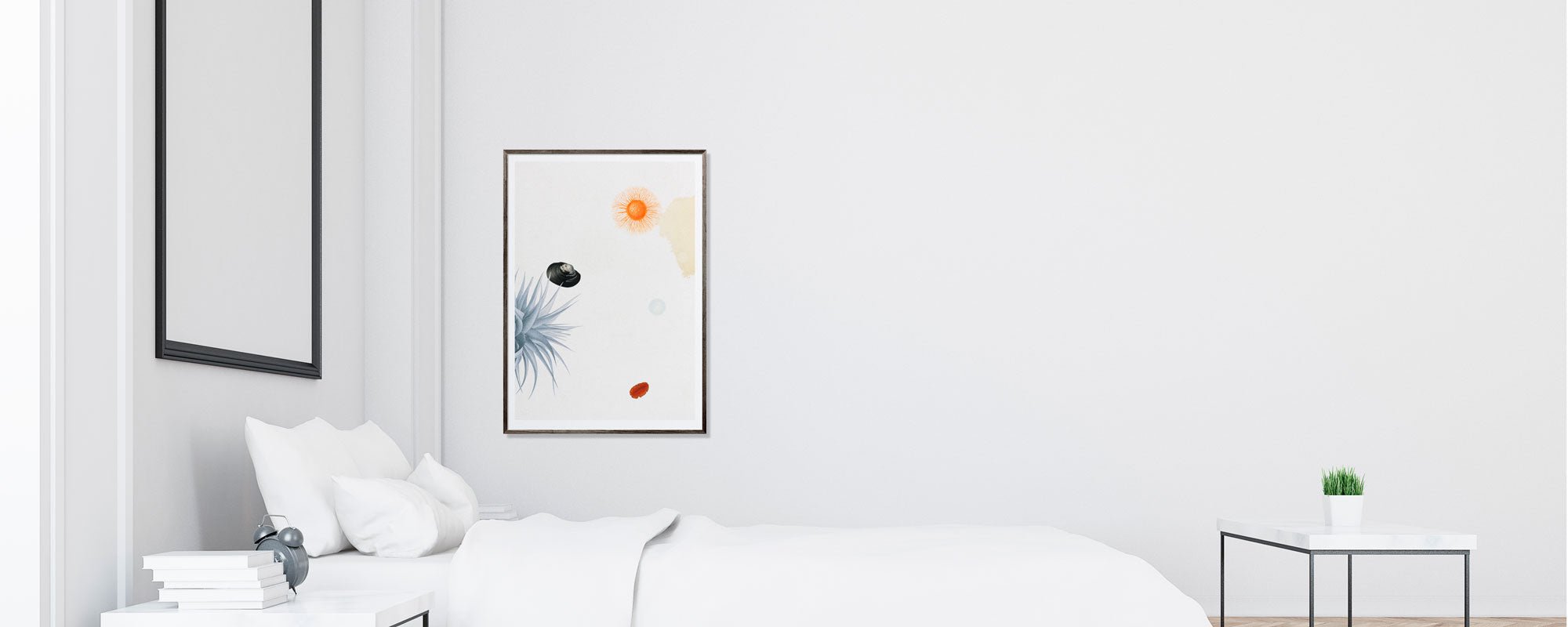
Sluseholmen Art Gallery with peace and presence
An art gallery on Sluseholmen doesn't have to be like a traditional, white exhibition space where you whisper between the artworks. In the former industrial area by Copenhagen's harbour, the art experience can be more down-to-earth and at the same time more refined: a place where the texture of paper, a deep pigment colour, and the scent of fresh coffee are allowed to coexist in the same atmosphere. For the design-conscious visitor, it is precisely in this encounter between art, space, and daily ritual that an artwork becomes present.
Sluseholmen has a special rhythm. The canals, the striking buildings, and the area's mix of residential life, working days, and water create a modern Copenhagen backdrop with room for contemplation. Here, a gallery makes sense as a sensory sanctuary – not as a quick interruption, but as a place where the gaze can find peace.
Art Gallery Sluseholmen as a physical experience
When art is exclusively encountered on a screen, the scale often becomes imprecise. A motif that appears graphic and stark on the phone can reveal an almost tactile depth on the wall. The paper might have a warm, soft surface. A canvas can absorb light differently than a framed print. And handmade details in gold leaf change as you move past the artwork.
The physical gallery accommodates these differences. You see if a piece needs space around it, if it can carry a large wall, or if it rather functions as a precise visual point in a bookshelf, hallway, or study. This is an essential part of a well-considered art decision, especially when the home already contains furniture, textiles, and objects with a clear aesthetic voice.
A good gallery visit is therefore not just about choosing. It's about feeling. Some artworks demand attention with contrast, dramatic archival motifs, or a sharp collage. Others work more subtly with tone, negative space, and poetic shifts. Both can have great power, but they don't necessarily suit the same room or the same rhythm of life.
From wall decoration to artwork with presence
The difference between decorative wall art and an artwork with lasting meaning rarely lies in whether the motif is easy to decipher. It lies in the intention, the material, and the visual tension that continues to unfold. A curated fine art print can be accessible in price and format without being anonymous. It can bear traces of the artist's hand and a composition that has enough resistance to feel interesting year after year.
Giclée prints are a good example. When pigment prints are produced on exclusive fine art paper or canvas, the colours achieve a precision and depth that ordinary poster prints rarely can maintain. Black becomes more nuanced. Dusty tones acquire a vibrant presence. Small details in a collage or illustration stand out more clearly.
But technique alone doesn't make a work strong. It must serve the image. A heavy, tactile paper often pairs beautifully with works of architectural calm or photographic traces, while canvas can provide more corporeality and painterly weight. The right format depends on both the motif and the space the work will inhabit.
Editions make the choice more personal
Limited editions add another form of value. Numbering and signatures not only make the work more collectible but also clarify that the edition is limited. It is a conscious alternative to endless reproduction, where the image loses its uniqueness the more places it appears.
Hand-finishing can further enhance this individuality. A touch of 24-carat gold leaf is never quite the same from one work to another. Light meets the surface differently, and the hand-applied finish creates a subtle variation that makes each piece more than an identical copy. It is not an effect meant to overpower the motif, but a detail that gives the work a changing life.
How to choose art for your space
The most successful art purchase often begins with the space, but it shouldn't end there. It's sensible to consider the wall's dimensions, the incidence of light, and the dominant materials in the decor. A large artwork can unify a living room with low furniture and calm surfaces, while a smaller edition can create intensity in a narrow passage or above a desk.
Nevertheless, colour matching shouldn't be the only criterion. Art is allowed to slightly disrupt a decor. In a neutral interior, a work with deep blues, faded reds, or golden reflections can create character without making the room feel restless. In a home with many colours, a more monochrome composition can serve as a visual break.
Also ask what you wish to return to. An artwork doesn't necessarily have to explain itself at first glance. On the contrary, the best art can have an element that you only discover later: a cropped figure, a shifted horizon, a fragment from an old archive, or an almost imperceptible layer on the image's surface.
For hospitality environments, offices, and creative workplaces, a similar logic applies. Here, the artwork must both support the place's identity and have enough autonomy not to be reduced to mere background. Series with related motifs can create coherence across several rooms, while a single original piece can serve as a natural focal point in a reception or meeting room.
Coffee, studio, and art in the same space
When a gallery also houses a studio and coffeeshop, the pace changes. The visit is allowed to last longer than the time it takes to view a wall. You can sit down, discuss a motif, view a print from a distance, and return to it with fresh eyes. It's a simple, yet significant framework for art.
The studio's anchoring also adds credibility. Art is not just a finished product on a wall, but the result of choices: compositions, test prints, paper, colour management, framing, and finishing. This uncompromising attitude is noticeable when curation and production are not detached from each other.
At StoltzeStudio, these layers meet in a unified brand universe, where poetic compositions, fine art production, and café culture give art a concrete, human framework. This makes the place relevant for both the experienced collector and for those buying their first artwork with the ambition of keeping it for a long time.
A local visit with an international perspective
For international visitors, Sluseholmen might be a less obvious destination than the central museum districts. Precisely for this reason, the area has its own quality. It offers a more local experience of Copenhagen, where art is not isolated from everyday life, but is part of a vibrant waterfront neighbourhood.
For buyers who do not live in the city, the physical gallery can still serve as a reference point. It demonstrates the standards on which an online purchase is based: the quality of the materials, the logic of the editions, and the visual universe behind the works. A good artwork must be able to travel, but it should have a clear origin.
Next time you're looking for art for a wall, the question doesn't just have to be what fits. Rather, ask which image can give the room a new rhythm – and which still feels right when the coffee is drunk, the light has shifted, and everyday life has begun again.