Art experience with café and gallery
There's a difference between viewing art and residing within it. An art experience with a café and gallery creates precisely that distinction – from a quick glance at a wall to a more sensory encounter, where the pace slows, the gaze sharpens, and the works are allowed to resonate in the space around you.
For a design-conscious audience, this is not a minor detail. The setting matters. The light matters. The materials matter. When coffee, a gallery, and an atelier feel converge into one harmonious whole, art isn't just presented – it's lived with, even if only for an hour.
Why an art experience with a café and gallery feels different
A traditional gallery can be precise, quiet, and focused. It has its own strengths. But it can also feel like a space one passes through with a certain caution. The café changes that dynamic. It adds warmth, longevity, and a natural sense of presence.
It changes the way we look at artworks. When you're sitting with a cup of coffee in hand, the encounter becomes less ceremonial and often more honest. You linger longer. You return to the same motif. You notice the texture of the paper, the depth of the pigment, the balance in a composition. That kind of insight requires time, and time rarely arises in a space that feels too rigid or too rushed.
At the same time, there's a clear qualitative difference between places where a café and gallery merely exist side-by-side, and places where they are conceived as a single, unified universe. The latter is what's truly interesting. Here, the aroma, the acoustics, the furnishings, and the selection of works are not random elements, but parts of the same curated experience.
When the atmosphere becomes part of the artwork
The most profound art experience rarely arises from over-information. It emerges in the tension between the artwork and the space in which it is displayed. A well-composed café-gallery experience can support precisely this. Not by stealing attention, but by creating an atmosphere where the artwork can come into sharper focus.
This is particularly noticeable when the material quality is high. Fine art prints with precise color reproduction, works on exclusive paper, canvas with tactile depth, or hand-finished details like gold leaf behave differently in light and distance. They don't necessarily require explanation, but they do require a space that grants them dignity.
Here, the café's role becomes more refined than mere service. It acts as a sensory sanctuary. Not a break from the art, but an extension of it. The cup on the table, the hushed conversation, the pause between two glances at the same work – all of this makes the experience more human and often more memorable.
Art experience with café and gallery as curated lifestyle
For many, buying art is no longer an isolated transaction. It's part of a broader aesthetic decision about how one wants to live, decorate, and surround oneself. That's why the format makes sense. An art experience with a café and gallery speaks to people who are not seeking standardized wall decoration, but works with character, tranquility, and artistic integrity.
This applies to both private homes and more professional environments. In a home, art adds depth and identity. In an office, a hotel, or a hospitality space, it can set the tone for the entire experience. But in both cases, the choice is rarely just visual. It's also about atmosphere, materiality, and narrative.
Precisely for this reason, the most interesting places have a clear stance on curation. They don't show everything to everyone. They choose with care. There's a noticeable difference between a space with strong editing and a space where too many expressions compete. When the selection is sharp, each series, each format, and each finish gains more weight.
What you notice when the quality is real
A trained eye quickly discerns the difference between decorative surface and genuine artistic production. But even the less experienced visitor feels it. Quality has a way of communicating without elaborate words.
It can lie in the weight of the paper, in the calm of the matte surface, or in the way a Giclée print keeps nuances open instead of flattening them. It can also lie in the logic of editions – numbering, signature, and a clear limitation that makes the work more personal and less interchangeable.
Hand-finished details are a good example. They must be applied with a steady hand. When well-integrated, they add not just luxury, but precision. A touch of 24 karat gold leaf can change a work's rhythm, catch the light differently throughout the day, and give the composition an almost quiet glow. If, on the other hand, the effect is used too decoratively, it loses credibility. Quality is always a matter of balance.
The café makes the decision more informed
There's a practical side to the format that is often underestimated. Art takes time to choose correctly. Especially if the work is to live with you for many years. In a café-gallery context, you get the opportunity to let the first impression settle.
This is valuable because the best purchases are rarely made in haste. A work that seems quiet at first glance can grow significantly when you give it ten extra minutes. Conversely, a very impactful motif can lose its strength once the initial fascination has subsided. You only notice that difference if you are allowed to stay.
Therefore, this type of space is particularly strong for novice collectors as well as more experienced buyers. It removes some of the classic distance and replaces it with immersion. Not in a casual way, but in a more generous way.
A physical space in a digital art world
We are perfectly comfortable discovering art online. It is efficient, global, and often inspiring. But the screen cannot fully reproduce scale, surface, and presence. It can show the composition, but rarely the full temperature of the work.
Here, the physical space gains new meaning. Not as an opposite to the digital, but as a correction. When you stand before an original work or an exclusively produced print, you perceive far more than just the motif. You see the sharpness of the edge, the depth of black, the tension between matte and reflective fields. This is the kind of information that makes a real difference for quality-conscious buyers.
In that sense, the café-gallery is not old-fashioned. On the contrary. It is an answer to a time when much visual culture has become fast and frictionless. The physical encounter reintroduces resistance, nuance, and concentration.
When a place has identity, you remember it
The most compelling art environments are those where you can feel a clear author. Not necessarily through grand explanations, but through consistency. Color scheme, furnishings, service, artwork selection, and tone must speak the same language.
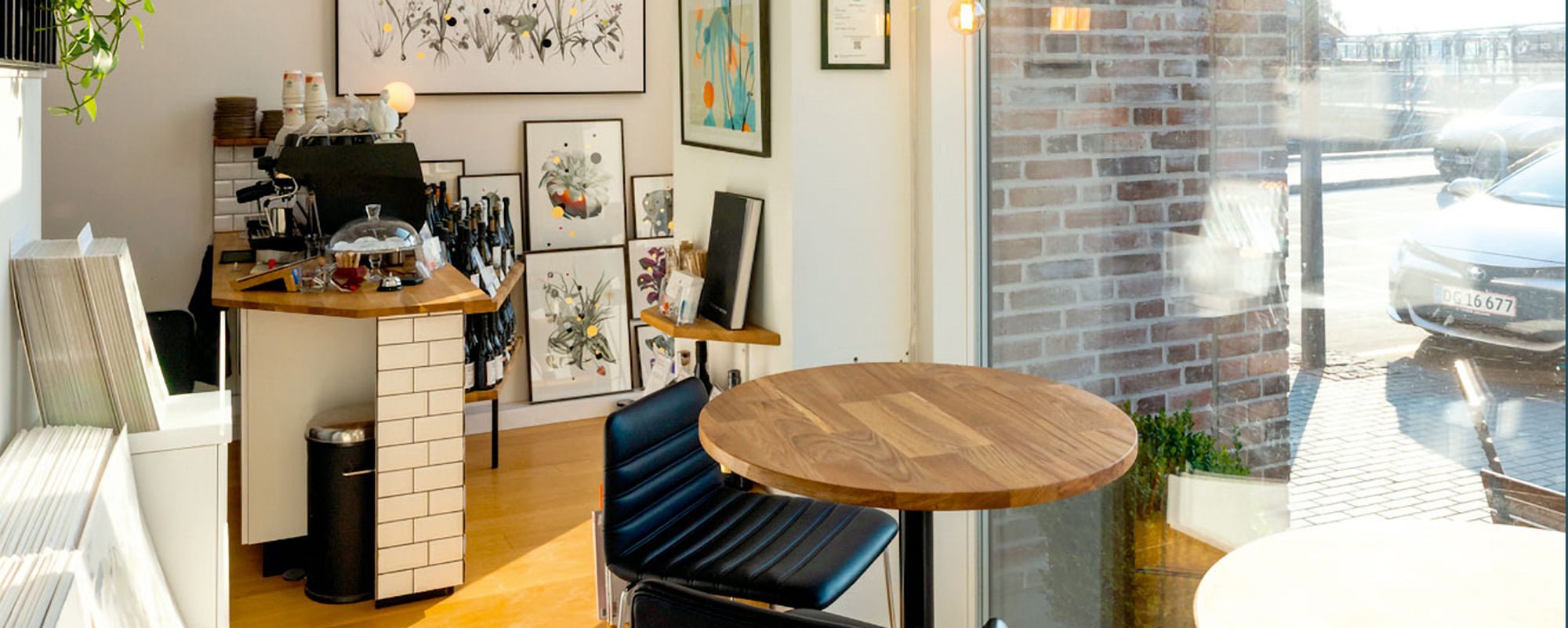
This is where a place like StoltzeStudio becomes interesting in a Copenhagen context. Not just as a gallery or café, but as a unified brand universe where atelier roots, craftsmanship, and curated tranquility are conceived as one experience. That kind of place doesn't just attract visits, but builds relationships.
For an audience with an eye for design and artistic distinctiveness, this is crucial. You don't just come to buy something for the wall. You come to sense if the place has integrity. If the works are selected with conviction. If the atmosphere supports what is being shown. That cannot be faked for long.
Who benefits most from the format?
The format is particularly well-suited for people who want to combine aesthetic immersion with a more relaxed rhythm. Couples spending an afternoon viewing art together. Creative professionals seeking visual nourishment. Homeowners who want to see artworks in an environment that feels lived-in and not clinical.
This does not mean the experience should be non-committal. On the contrary. It can certainly be sharp, demanding, and quality-conscious. But it should also be hospitable. That is precisely the interesting tension – high curation without coldness, sensuality without noise, premium without stiffness.
If you are looking for this type of experience, it is worth choosing places where the café and gallery are actually mutually reinforcing. When they are, the visit becomes more than a break in the day. It becomes a space where taste, materiality, and attention fall into place. And sometimes, that is precisely where you find the work you didn't know you were looking for.