Studio visit or online art purchase?
There is a crucial moment in every art purchase: the second a work goes from being something you admire to something you imagine living with. The question of studio visits versus online art purchases is therefore not just about convenience. It's about presence, materiality, proportions, and the particular sense of certainty that arises when aesthetic appeal also feels right in practice.
For some buyers, the answer is simple. They want to feel the weight of the paper, see the depth of the pigments, and experience a work in natural light before making a decision. For others, the online format has become the most precise way to buy art with peace of mind and clarity, especially when the selection is carefully curated and the information thoughtfully presented. Neither is more "right" than the other. But the two ways of buying art offer different kinds of insight.
Studio visit or online art purchase – which offers the most value?
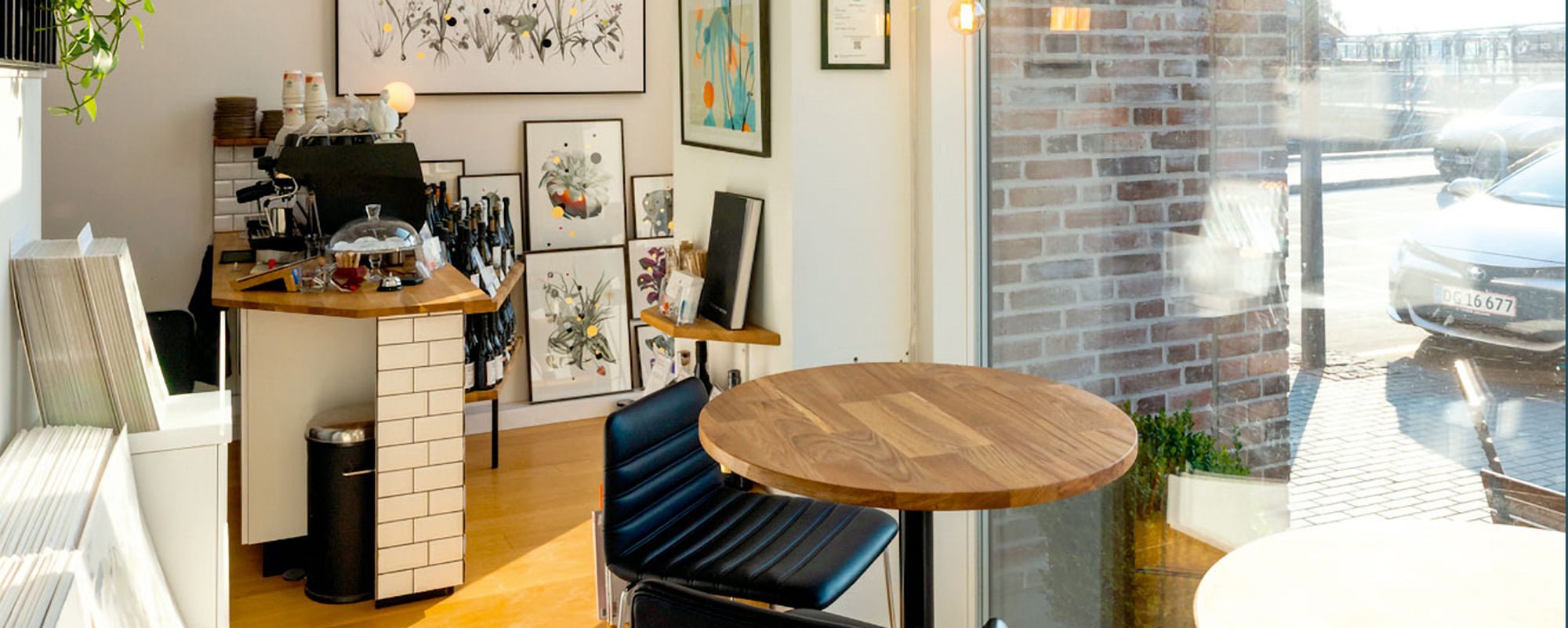
A studio visit offers something no screen can fully replace: the bodily experience of the artwork. Scale is perceived differently when standing in front of it. Surfaces are read more accurately. Hand-finished details – such as gold leaf, canvas texture, or subtle variations in the print – emerge with a different authority when the eye is allowed to wander up close.
This is particularly relevant if you are considering original artworks, limited editions, or prints with special material qualities. Fine art print is not just a motif reproduced on paper. The quality lies in the entirety: pigment, paper type, edge, tone, finish, and the discipline involved in production. A studio visit can make that difference clear in minutes.
Online art purchasing, on the other hand, offers a different kind of luxury: time. You can return to a work multiple times, compare formats at leisure, hold it against the room's colors, and think without pressure. The digital space allows for reflection. For many, this is precisely where a good decision is made – not in the mood of the moment, but in gradual clarification.
When the physical space makes a difference
There are works that almost only fully reveal themselves in a physical encounter. This is especially true for compositions with many layers, tactile surfaces, or a delicate balance between light, shadow, and material. A collage-based art poster may appear graphically sharp and simple online, but in reality, it may contain a poetic complexity that only becomes apparent up close. A giclée print on exclusive paper may look good on screen, but in hand, it gains the weight and sophistication that explains its price and position.
The physical encounter also makes it easier to assess format. Many underestimate how much size matters. A work that seems discreet online can actually have a strong architectural presence. Conversely, a motif you thought would dominate a room might turn out to have an almost quiet elegance.
For the home-conscious buyer, this is not a detail. Art is not an accessory. It affects the rhythm of a room, the relationship between furniture, light incidence, and the pauses the eye seeks during a day. A studio visit makes it easier to discern this effect.
At the same time, personal dialogue is often valuable. Not as a sales tactic, but as curation. A qualified conversation about format, hanging, edition, framing, or material choice can save the buyer both doubt and mispurchase. In a good studio environment, art is not just displayed. It is related to how it should actually be lived with.
Where online art buying is often the best solution
Online art buying is not a second priority. For many, it's the most intelligent path, especially when you already know what aesthetic you're looking for. If the curation is strong, the images precise, and the work descriptions honest, the online format can be both effective and secure.
This is particularly true when purchasing works where the expression is largely carried by motif, color scheme, and compositional balance. Here, the digital presentation can be surprisingly accurate, as long as the product photography is good and clear information is provided about paper, canvas, edition, signature, and dimensions.
Online is also an advantage when furnishing multiple rooms or buying art across geographies. International buyers rarely have the opportunity to visit a studio but can still select works with great confidence if the presentation is professional and the focus on materials is not reduced to marketing platitudes. This requires transparency, not just beautiful images.
In addition, online purchasing offers a more cohesive decision-making space. You can view the work in relation to your own walls, save favorites, measure up, and consider frames and placement. This kind of slow decision-making is well-suited to art. Not because the purchase has to be difficult, but because good choices often mature over time.
Studio visit or online art purchase for prints and originals
The difference between the two buying situations becomes clearer when distinguishing between prints and original works. For original works, many will find that a studio visit has particular value. Here, brushwork, materiality, minor irregularities, and the actual aura of the work play a greater role. The original lives in its details, and these are best read physically.
For fine art prints, the picture is more nuanced. High-quality print production today is so refined that a good decision can often be made online if the provider works uncompromisingly with materials and documentation. But the more a print relies on special finishing details – hand-finishing, gold leaf, texture, or exclusive paper qualities – the more the physical encounter speaks for itself.
Limited editions fall somewhere in between. Here, you buy both the motif and the object quality. Numbering, signature, and the character of the edition make the work more collector-oriented, and therefore questions of authenticity, execution, and presentation become extra important. Some buyers feel most comfortable seeing these details in reality. Others are perfectly comfortable online if the communication is precise enough.
How to choose what's right for you
The best choice depends less on what is generally smartest, and more on what kind of buyer you are. If you make decisions with your eyes and body as much as with analysis, a studio visit will often provide greater peace of mind. If you prefer to compare, measure, and think at your own pace, online is probably the better framework.
Budget also plays a role, but not necessarily as one might think. A smaller purchase can still warrant a physical visit if the work is to have a central place in the home. Conversely, a larger purchase can easily be made online if you have experience with art buying and trust the curation.
It's also worth considering how sensitive you are to material. Some react strongly to the difference between matte and more vibrant surfaces, between cotton paper and canvas, between cool and warm tones in the print. If you know that such things matter a lot to you, a physical meeting is often worth the time.
For others, it is the narrative and the visual whole that drives the decision. They seek a work with character, tranquility, and clear artistic integrity, and here an online presentation can be fully sufficient. Especially when the works are curated with a clear aesthetic signature, as one experiences it in a place like StoltzeStudio.
The most precise answer is often both
There is a middle ground that many overlook. You can start online and finish physically, or conversely, experience the work in a studio and only buy later, once the decision has settled. One format does not have to exclude the other. On the contrary, they complement each other surprisingly well.
Online can serve as the first encounter – a curated overview where style, series, and format become clear. The studio can then provide the final clarification on material, scale, and atmosphere. Or you might have had the sensory experience first and then use the digital calm to choose precisely the work you actually want to live with.
The most important thing is not whether the purchase happens in front of a screen or in a physical space. The most important thing is whether the work is allowed to be chosen with the attention it deserves. Good art can withstand being seen twice. It often benefits from it.