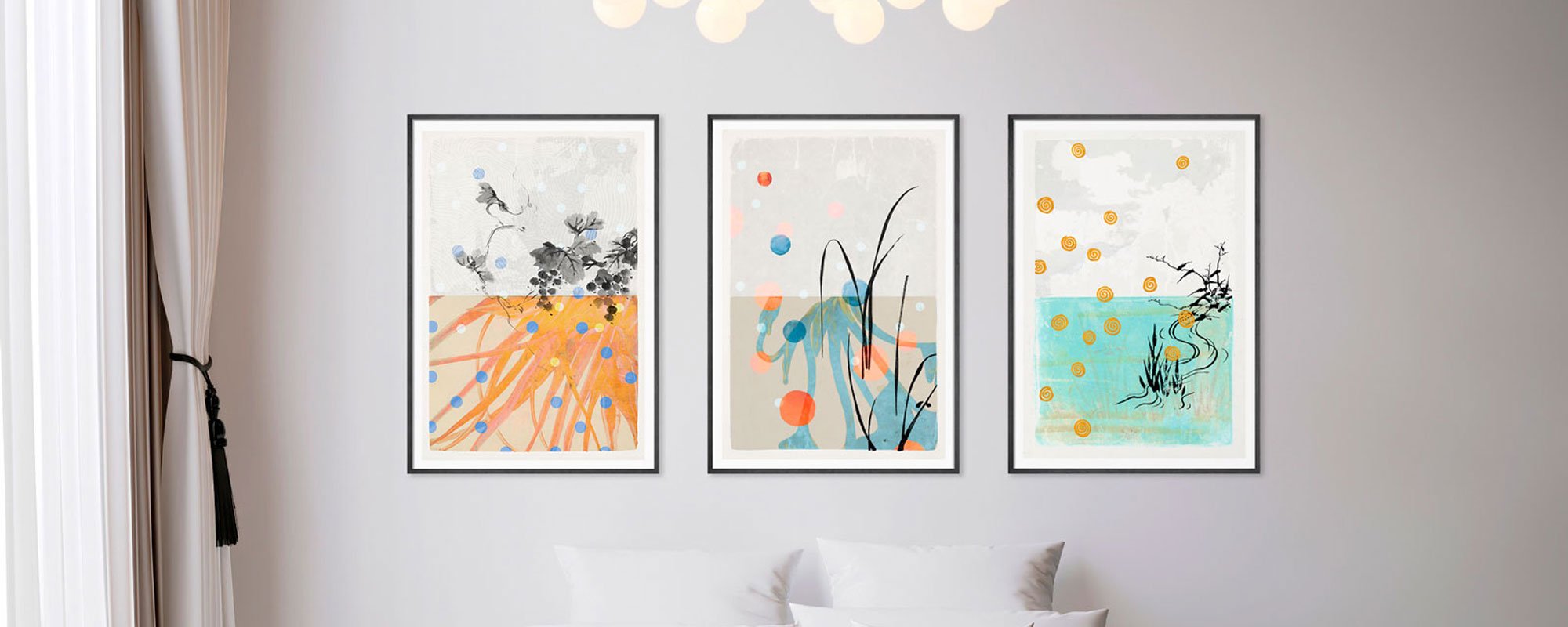
Original art for the home with lasting presence
A room quickly reveals itself. Not through its size, but through what is allowed to remain on its walls. Original art for the home does something that furniture and paint swatches rarely can alone – it adds weight, rhythm, and a personal perspective on the world. When a piece is chosen with care, it doesn't just become a decoration, but a quiet voice in everyday life.
Therefore, the question isn't just what matches the sofa or the wall color. The more interesting question is what you want to live with. Which motif, which texture, and which energy should greet you in the morning, accompany dinner, and become a part of the home's slower hours?
Why original art for the home feels different
There's a noticeable difference between mass-produced wall decor and an original work. This difference isn't just in price or rarity, but in presence. In original art, there are traces of decisions, adjustments, and the movement of the hand. The surface has life. The color has depth. The composition often has a more complex balance because it wasn't developed to appeal to as many people as possible, but to stand strong in itself.
This is precisely why many design-conscious home buyers seek out works with clear artistic integrity. A home with original art rarely appears over-styled. It appears cohesive. Not because everything matches, but because something in the room has real character. That character rubs off on the whole.
At the same time, original art isn't necessarily the same as large, dramatic canvases. It can also be smaller works on paper, collage-based compositions, or hand-finished editions, where material quality and limited edition sizes create the experience of something special. For many, it's the more nuanced path into the world of art collecting.
Choose works based on mood, not just color
One of the most common mistakes in home decor is choosing art too late and too tactically. People look for something that "goes with" the decor and end up with a piece that solves a color problem but adds nothing substantial to the home. Art should not be reduced to the last link in the styling chain.
The more precise starting point is mood. Should the room have calm, tension, warmth, contrast, or refined unrest? A bedroom often tolerates more quietness in motif and palette, while a dining room or entryway can handle a more striking composition. In workspaces, art with clear structure and tactile depth often provides more long-lasting energy than decorative trend motifs.
Colors, of course, matter, but they should be read as temperature rather than a definitive answer. Muted earth tones, chalky nuances, black-and-white contrasts, or poetic archive motifs affect the experience of a room differently. When you choose based on mood first, the result is almost always more convincing.
Materials change the experience
Two works can have the same motif and yet feel completely different. The weight of the paper, the depth of the pigments, the texture of the canvas, and the handmade details all significantly impact how a work is perceived in a room. Giclée prints on exclusive paper often have a velvety color reproduction and a precision that suits both photographic motifs and complex collages. On canvas, the work takes on a different body and more painterly weight.
Hand-finished details can elevate the experience further. A discreet layer of 24-carat gold leaf, a textured surface, or a signed and numbered edition not only adds exclusivity but also a sense of closeness to the process. For the quality-conscious buyer, it is often precisely these details that distinguish a good work from a work one keeps returning to.
Size, placement, and proportions
Good art deserves correct scale. Far too many works hang too small on too large walls and thus lose their impact. A work doesn't necessarily have to dominate the room, but it must have enough visual mass to hold its position.
Above a sofa or a sideboard, it often works best when the artwork or group of works occupies a clear portion of the furniture's width. In smaller rooms, a single smaller work can be more refined than an overcrowded salon hanging. Conversely, large walls may need one work with calm and authority rather than many small interruptions.
Hanging height also plays a role. Art should be met by the gaze, not float up near the ceiling. It sounds trivial, but precisely the physical relationship between the work and the body is crucial for whether the room feels balanced. Original art for the home works best when it is not just placed, but truly installed with care.
One strong work or a curated series?
It depends on the room's temperament. One striking work can create calm and focus, especially in rooms with many materials and furniture. A curated series, on the other hand, can add rhythm and narrative if the works speak to each other in tone, motif, or format.
Here, uncompromisingness is more important than volume. Three works with clear cohesion are more impactful than five that are only connected by convenience. If you are working with multiple pieces, think about composition, space, and repetition. The curated eye is often the difference between a wall with art and a room with character.
What makes a work long-lasting?
Long-lasting art is not necessarily neutral art. On the contrary. The most enduring works often have distinctiveness, but they don't shout. They continue to unfold because they contain more layers than the immediately decorative.
It can be a motif with ambiguity, a composition with precise tension, or a surface that changes with the light. It can also be a work that carries a clear artistic method – collage, transformation, photographic archival work, or hand-finished layers. When the process can be felt, depth emerges.
Trends naturally influence everyone's perception. But if a work is chosen solely because it feels current, it often loses power when the trend shifts. Therefore, it is better to choose art that you feel a lasting curiosity for. Not necessarily something you fully understand immediately, but something you want to live with for a long time.
Personal curation matters more than perfect matches
A refined home rarely consists of perfect matches. It consists of conscious choices. Original art gains the most value when it is not forced into a ready-made formula, but is allowed to set the tone along with furniture, books, textiles, and objects with their own character.
That's why personal curation means so much. When works are chosen based on the room, light, materials, and the person who will live with them, a different kind of precision emerges. Not the strict, schematic precision, but the more sensory form of rightness. The one where a work suddenly makes the entire room more cohesive.
In a studio like StoltzeStudio, the value of this approach is particularly evident. Here, art is not presented as standard solutions, but as works with format, finish, and clear artistic intention. This leads to better decisions – especially for buyers who want more than just to fill an empty wall.
When original art also has to work in everyday life
A home is not a gallery in the clinical sense. Coffee is made, conversations are held, chairs are moved, and ordinary days are lived. Therefore, art must also be able to function in practice. In rooms with a lot of sunlight, material quality and framing are important. In kitchen-living rooms, works should be able to withstand a more active environment. In smaller apartments, works on paper can be an elegant solution, as they provide high visual quality without weighing down the space.
However, the practical must not be confused with caution. Art is allowed to have presence. In fact, everyday life often becomes more beautiful with works that take up a little space in consciousness. Not as a disturbance, but as a sensory breathing space amidst all the functional.
This is perhaps the finest reason to choose original art for the home. Not to signal something outwardly, but to create a place with more depth to be in. A home doesn't need more things. It needs better choices. And sometimes those choices begin with one work that makes the rest of the room fall into place.