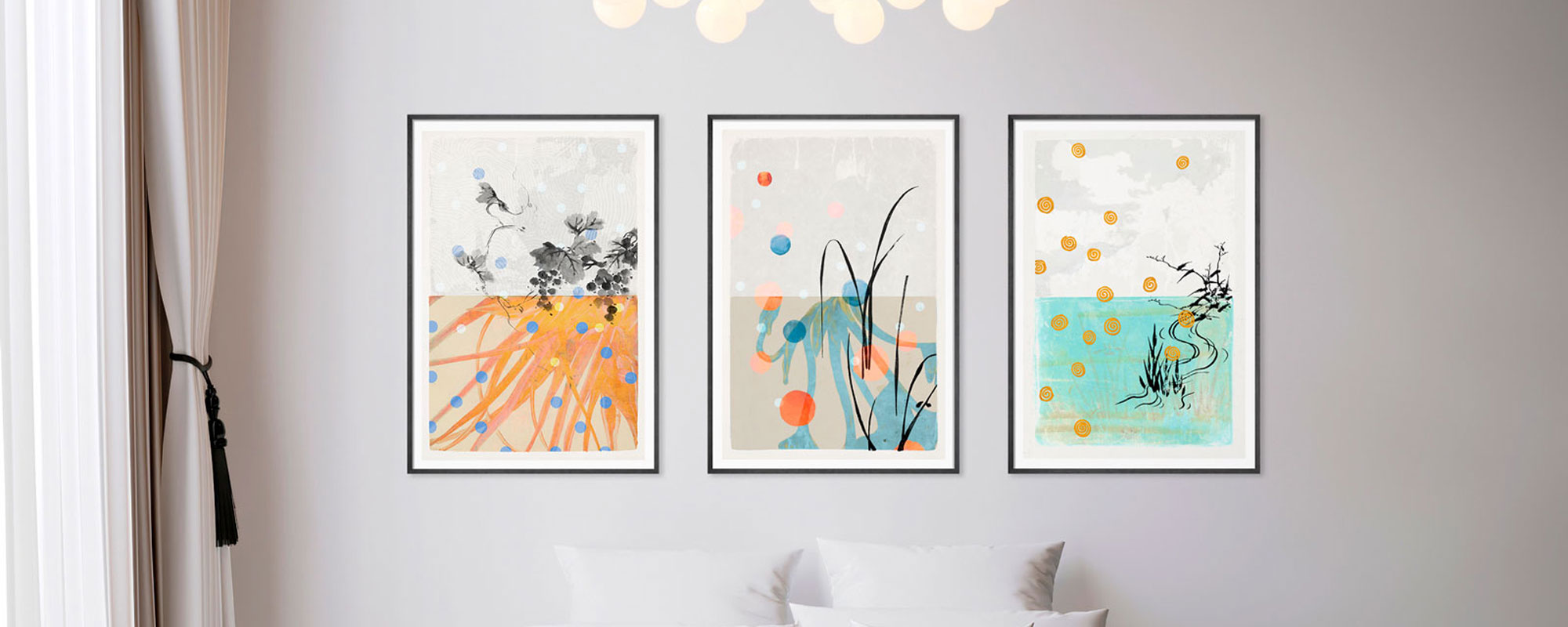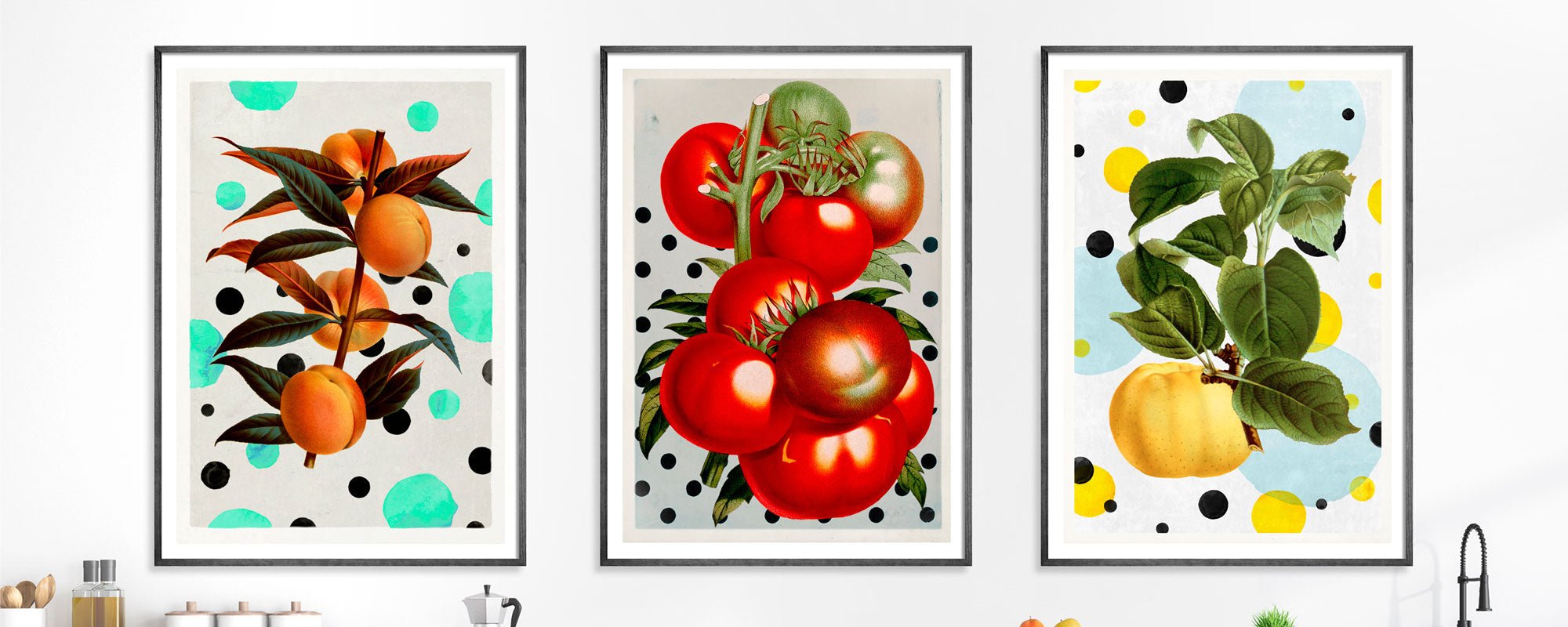
Poster or art print for the right wall
A motif can be the same, while the experience on the wall is vastly different. The question of poster or art print is therefore not just about price, size, or color. It's about how close you want to get to the materiality of the work, its depth, and the artistic intention behind it.
A well-chosen poster can give a room energy, direction, and graphic sharpness. A fine art print, on the other hand, can create a more subdued, sensory presence, where the paper's texture, the pigments' saturation, and the edition's details become part of the work. Both have their justification. The crucial thing is what your wall needs to be able to carry.
Poster or art print - the difference is in the detail
The word poster is often used broadly for wall art on paper. In its classic form, the poster is reproduced in larger editions, typically focusing on a clear motif, a graphic idea, or a decorative composition. It is created to be accessible, visual, and immediately legible from a distance.
An art print, however, is an artistic reproduction, where the production and material are chosen to preserve the special qualities of the work. It can be a Giclée print with pigment-based ink on thick, archival art paper or canvas. Here, the nuances in a collage, the grainy surface of an archival motif, and the small shifts in color tone are not smoothed out, but precisely preserved.
The difference is not always black and white. A poster can easily be beautiful, well-thought-out, and well-produced, while an art print is not automatically interesting just because it is printed on fine paper. But when a work is created with uncompromising quality in motif, technique, and finish, its character changes. It becomes less wall decoration and more a work you continue to look at.
When the motif needs to work with the room
The first question is not necessarily whether you prefer a poster or an art print. Rather, ask what atmosphere the room calls for. A poster with a strong typographic surface or a striking color contrast can unify an entryway, a kitchen, or a creative work environment. It can act as a precise visual impact - clear, urban, and energetic.
In the living room, bedroom, or a quiet corner with good materials, an art print can often emerge in a more complex way. Poetic compositions, processed archival images, and collages with many layers need time. They reward a gaze that moves closer, and they create a calm that doesn't need to shout to be present.
Scale is as crucial as the motif. A smaller work, around 30 x 40 cm or 12 x 16 inches, can create an intimate, almost collector-like feeling, especially when hung alone or as part of a tight gallery wall. A larger format above the sofa or in a hotel lobby needs more visual weight. Here, a work on canvas or a print with deep tones and a distinct tactile surface can give the room the necessary gravitas.
The paper is not just a background
For fine art prints, the paper is an active part of the expression. A matte cotton paper absorbs light softly and gives the colors an almost velvety depth. It is particularly well-suited for works with organic shapes, subdued palettes, and photographic or collage-based layers.
A smoother art paper can emphasize sharp contours and intensity in color. It is well-suited for graphic works where the composition thrives on contrast, rhythm, and precise surfaces. Canvas adds another dimension: a more painterly presence, where the work gains volume and can stand strong without glass.
A standard poster is often printed on thinner, smoother paper. This is not necessarily a weakness. For a purely graphic motif, the light surface can emphasize a direct and modern expression. But if the motif contains subtle shadows, tactile elements, or complex color transitions, an exclusive paper will often make a noticeable difference.
Glass and framing also affect the reading. Anti-reflective glass preserves the details of an art print in rooms with many windows, while ordinary glass can be a good choice in a more subdued room. A narrow oak frame adds warmth. A black frame creates graphic discipline. A passepartout provides space, but can also make a small work more formal. There is no single correct solution - only the framing that makes the work and the room speak the same language.
Edition, signature, and the personal trace
When you buy a limited edition art print, you are not buying a unique original work, but you are choosing something with a clear limitation and origin. The numbering of the edition indicates how many copies exist. A signature marks the artist's presence. Together, they give the work a different collector's value than a motif in unlimited circulation.
For many, however, the greatest value is not rarity alone. It is the feeling of owning a work that has been produced with care and with respect for the original composition. Hand-finished details, such as 24-karat gold leaf, also make each copy slightly different. The light never hits quite the same, and the surface takes on its own quiet life throughout the day.
It is here that the art print moves from reproduction to object. It can still be accessible in price compared to an original work, but it bears traces of the studio, the hand, and the material. For those who furnish with fewer, better things, this difference can be crucial.
When is a poster the right choice?
A poster is a strong choice when you want to work more freely with change, series, or graphic pulse. Perhaps you want to give a guest room a new identity, create an informal salon wall, or give an office a visual boost without making every motif an investment. Posters are also ideal when the room already has many tactile elements - textiles, books, ceramics, and wood - and the wall needs a simpler counterpoint.
Feel free to choose a poster because its expression feels right, not because it is the cheaper category. A well-composed poster with strong color balance and good printing can be the precise solution. It doesn't need to apologize for being a poster.
The art print makes more sense when the work needs to be an anchor in the room. This applies to the empty wall you see every morning, the space above the dining table, or the reception where the first atmosphere needs to be established. Here, material, edition, and craftsmanship are allowed to do their work over time.
Buy with your eyes - and live with the work
The screen image is only the beginning. When you evaluate a work online, imagine not only the color on the wall but also the light in the room: cool morning light, warm afternoon light, and artificial light in the evening. Dark blue tones can become almost velvety in shadow, while gold leaf or warm pigments can open up significantly in sunlight.
Also consider what the work should be placed with. An art print doesn't need to match the sofa or carpet. Often, the most refined tension arises when it adds a color, a texture, or a narrative that the room otherwise lacks. A quiet work can make a colorful home more cohesive. A bold motif can give a neutral interior personality.
At StoltzeStudio, fine art prints and art posters meet in a curated field, where the visual motif is always accompanied by respect for paper, edition, and finish. The same sensuality one seeks in a work should also be present in the choice itself.
The best choice is rarely the one that takes up the most space on the wall or fits best into a fleeting trend. Choose the work that makes you want to stop - even when the room has become part of your everyday life.