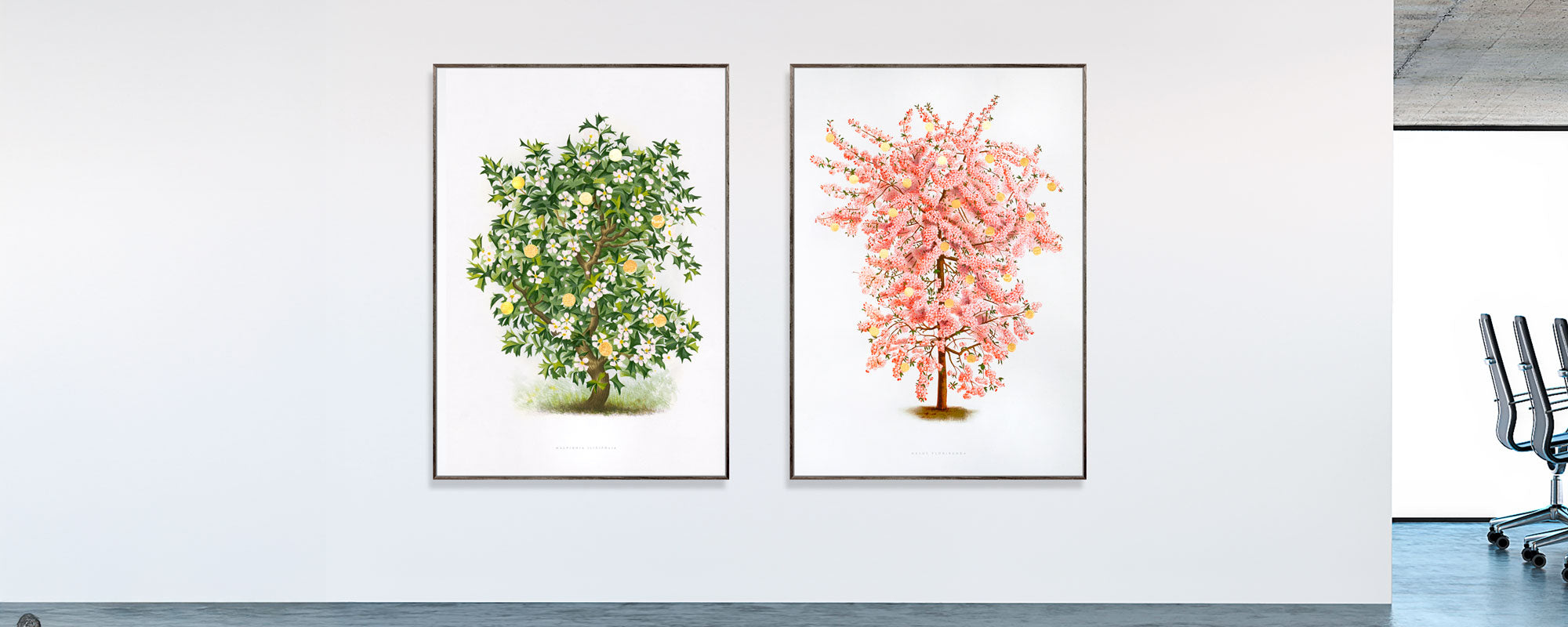
How to decorate with art with calm and gravity
A room can be perfectly furnished and still feel unfinished. Not because more items are missing, but because it lacks a focal point with presence. Here's how to decorate with art if you want a home with character, calm, and visual depth—not just walls filled in.
Art is rarely the final layer. It should be considered earlier, as an active part of the room's rhythm, light, and atmosphere. When a piece is allowed to define a wall, a corner, or an axis in the room, a different kind of balance emerges. More personal. More precise.
How to decorate with art without over-decorating
The most compelling art decor isn't about quantity, but intensity. A single strong piece can carry an entire room if it has space around it. Conversely, several smaller pieces can create a nice rhythm, but only if they are curated thoughtfully.
Many people fail by treating art as an accessory. This diminishes the work. Instead, think of art as the room's mood-setter. Ask yourself what the piece should contribute. Should it create calm in a bedroom, an edge in an entryway, or contemplation in a living room? Only when the function is clear does the choice become sharper.
This also means that not every wall needs art. Empty spaces are not a problem if they give room to the works that actually matter. In a refined home, omission is just as important as inclusion.
Start with the room, not the wall
It's tempting to focus on a bare wall and find something that fits the dimensions. But good art decoration starts with the room as a whole. Observe the light throughout the day, the materials in the floor and textiles, and how the gaze moves when you enter.
A room with soft textures, muted colors, and natural materials can support works with tactility, materiality, and poetic compositions. A more graphic interior with sharp lines and contrasts can benefit from art with clear structure, archival references, or striking visual planes. There is no single correct solution, but there is always a more conscious solution.
Scale is crucial. A small piece on a large wall can appear timid, unless it is deliberately placed that way and supported by furniture or objects around it. A large piece, on the other hand, can unify a room with minimal effort, especially if you want a calm expression without visual noise.
Choose art by mood, not just color
Many people choose art by matching shades with their sofa, rug, or curtains. This can work, but it's rarely the most interesting approach. Art doesn't necessarily have to blend in with the interior. It's allowed to create tension.
Instead, look at temperature and tone. Is the room warm or cool? Quiet or energetic? A piece in muted earth tones can still feel dramatic if the composition is intense. A bright motif can appear calm or unsettling depending on its lines, depth, and thematic tension.
It is often better to choose a piece that speaks to the room's mood than one that merely repeats the room's palette. When art adds a new layer, the decor becomes more vibrant.
Placement is what makes art land right
The classic mistake is hanging art too high. Works should meet the eye naturally, not float near the ceiling. As a rule, the center of the work should be placed around eye level, but this depends on the room's function, ceiling height, and furniture.
Above a sofa, sideboard, or bed, the artwork must relate to the furniture beneath it. It should not float disconnected. The width should often be about two-thirds of the furniture's width if you are working with a single piece. This is not a rule, but a good guideline.
In the dining room, art can be hung a little lower because you experience the room while seated. In an entryway, you can be bolder. Here, the space often tolerates a more striking first impression. In the bathroom or smaller passages, a smaller piece with a strong material feel can create a surprising degree of luxury.
Solo piece or gallery wall?
Both can be beautiful, but they require different temperaments. A solo piece creates authority and calm. It is well-suited for larger formats, limited editions, or works with strong materiality, where the details deserve distance and space.
A gallery wall works best when there is a clear connection—either in tone, motif, frame type, or compositional rhythm. Without that connection, the whole can seem hectic. If you mix very different art, something else should bind the pieces together, for example, uniform spacing between frames or a deliberate color line.
For many homes, the solution will lie somewhere in between. One dominant piece in the living room, a smaller curated hanging in the hallway or study, and a few carefully placed pieces in the rest of the home. This provides both variety and calm.
Frames, paper, and finish are not details
Materiality significantly alters the experience. A motif on exclusive paper with pigment depth is perceived differently than a standard print with a flat surface. Canvas offers a different physicality. Hand-finished details add light, texture, and intimacy, especially in rooms with changing daylight.
If you invest in art, the frame should not be an afterthought. It is the transition between the artwork and the room. A narrow oak frame provides warmth and calm. A black frame creates graphic sharpness. A floating frame around canvas can elevate the work and give it the necessary presence.
Glass also matters. Anti-reflective glass is often worth choosing in rooms with a lot of light or many windows. It allows the artwork to stand out more clearly. This is especially true if the motif has fine details or low contrast.
How to decorate with art in different rooms
In the living room, art should often help to bring things together. Larger formats make particular sense here because they can support the dialogue between the sofa, rug, table, and light. Choose one impactful piece rather than several half-hearted choices.
In the bedroom, art works best when it slows down the pace. Muted compositions, organic forms, and airy motifs create a sensory breathing space. Here, the artwork doesn't need to shout to be present.
In the home office, art can sharpen the focus. Something graphic, concentrated, or conceptual can provide energy without being distracting. If you work creatively, art with complexity can be more stimulating than purely decorative motifs.
Kitchens and dining areas are often overlooked, but precisely here, art can add warmth to functional surfaces. Choose works that can be seen in passing and up close. Motifs with rhythm, collage, or an archival character often work beautifully in these spaces.
Buy fewer works, but choose more sharply
The most sophisticated home is rarely the most filled. It is the most precise. If the budget doesn't stretch to large original works, there's a lot to be gained from fine art prints produced with high material quality and clear curation. Especially numbered and signed editions can provide the experience of intimacy, integrity, and collector's value.
Here, the difference between mass-produced wall decor and artistically crafted prints is clear. Paper, color depth, printing technique, and finish determine whether the artwork merely decorates or actually grounds the room. At StoltzeStudio, this uncompromising approach is evident in the intersection of motif, material, and craftsmanship.
Of course, it depends on how you live. A lively family home requires different choices than a quiet urban home or a hospitality environment. But the principle is the same: choose works you want to return to. Not just works that fit in for the moment.
Give art time
One of the finest things about decorating with art is that the relationship evolves. A good piece doesn't reveal everything at once. It continues to offer something—a detail, a mood, a shift in light, a new association.
Therefore, you don't need to have your entire home in place at once. Start with the room where you spend the most time. Choose one piece with aesthetic weight. See how it changes the atmosphere around it. When art is chosen with care, the rest of the decor often starts to fall into place more naturally.
The most beautiful home is rarely the most perfect. It is the one where every piece feels chosen—not just bought.