Best art forms for the workplace in practice
A meeting room with glass walls, uniform chairs, and a screen on a black stand doesn't have to look like a transit area. The best art forms for the workplace don't just add color to the wall; they establish an atmosphere: a visual counterpoint to the pace, a pause for the eye, and a clear sign that the company takes its surroundings seriously.
Art in the workplace is often chosen too late in the process. First comes the architecture, furniture, lighting, and technology. Finally, empty spaces appear that need to be "solved." But the strongest work environments use art as an integral part of the whole from the beginning. A piece can unify a reception area, give character to a quiet office, or turn a long hallway into a sequence of small visual stops.
The choice is therefore less about finding something neutral that no one can disagree with. It's about curating works that can continue to add depth to the space without demanding attention every time you step in.
Best art forms for the workplace: choose by space and rhythm
There isn't one art form that suits all companies. A creative agency, a law firm, a clinic, and a hotel environment have different rhythms, guests, and degrees of concentration. Nevertheless, some formats consistently work strongly because they can balance personality with calm.
Fine art prints with graphic precision
Curated fine art prints are an obvious choice in offices where a consistent visual identity across multiple rooms is desired. They can be produced in series, so that reception, meeting rooms, and work zones achieve a common tone without becoming uniform. A good print still has presence: the depth of the pigments, the tactility of the paper, and a composition that gradually reveals itself.
Abstract forms, archive-based motifs, and poetic landscapes often work particularly well. They leave room for individual interpretation and do not create the visual noise that an overly literal motif can. At the same time, they can be adapted to the scale of the room – from a smaller piece at a sitting workstation to a large format that anchors a lounge or entrance.
Paper quality should be part of the decision. A Giclée print on exclusive art paper has a richness and level of detail that ordinary posters rarely deliver. In professional environments, this difference is noticeable, especially when the works are seen up close in everyday life.
Abstract art for concentration and conversation
Abstract art is among the most versatile choices for the workplace because it doesn't tell a single, complete story. Color fields, organic lines, collage surfaces, and shifted forms can create energy, but also silence. It depends on the palette, contrast, and density of the work.
In spaces for contemplation, muted, tactile compositions often work best. Think dusty earth tones, deep ultramarine, grey-green hues, or warm tones with calm transitions. In areas with shorter stays, such as by the coffee station or in a hallway, a more striking piece can tolerate greater contrasts and a clearer graphic approach.
Abstraction is not the same as anonymity. On the contrary, a work with a clear artistic hand can give a workplace a more confident and personal identity than generic images of cities, bridges, or coastlines. Art should not explain the company. It should make its spaces more interesting to be in.
Photographic works with atmosphere
Photography can be precise, elegant, and very present, but it requires sharp editorial judgment. A photograph in a workplace should have a visual tension that goes beyond mere decoration. It could be a cropped architectural motif, an overlooked urban detail, a landscape with mist and distance, or a quiet study of materials and shadows.
Photographic works are particularly suitable for companies that wish to create a connection to place, culture, or craftsmanship. But be careful with overly predictable motifs. Large skyline images and standardized nature prints can quickly make a room look like a hotel that tried to be an office.
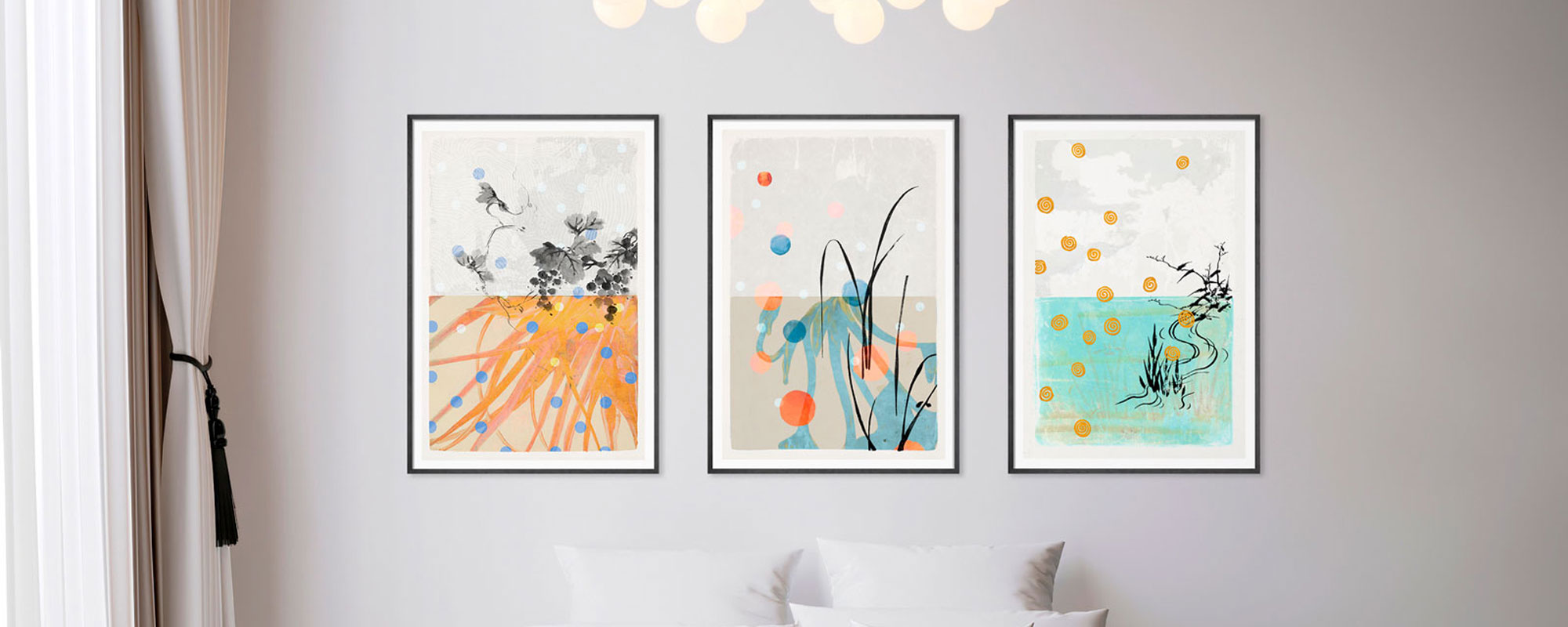
Instead, choose fewer photographs with strong tonality and high print quality. A series of three related works can give a corridor or a meeting room a nice rhythm, while one large photographic work can create a thoughtful weight in a waiting room.
Collage and visual transformation
Collage-based works hold a special place in workspaces where innovation, culture, and idea development are visible parts of everyday life. When archive motifs, typography, color fields, and fragments are combined in new ways, a visual tension arises between the familiar and the unexpected.
This art form is well-suited for common areas, creative studios, and meeting rooms where conversations might have a bit of an edge. It can be sophisticated without being heavy and playful without being childish. Precisely for this reason, collage is also suitable when a company wants to show boldness without making the interior aggressive.
The curation is crucial. If all works shout, the room becomes restless. Use one or two collage works as deliberate accents, and let them meet quieter surfaces, natural materials, or simple typography in the rest of the interior.
Original art and handcrafted details
In receptions, partner areas, executive spaces, and hospitality environments, original art can create a gravitas that reproductions alone do not always provide. An original work bears traces of the process: brushstrokes, layers, small shifts, and decisions that cannot be replicated. It signals that the space has been designed with intention.
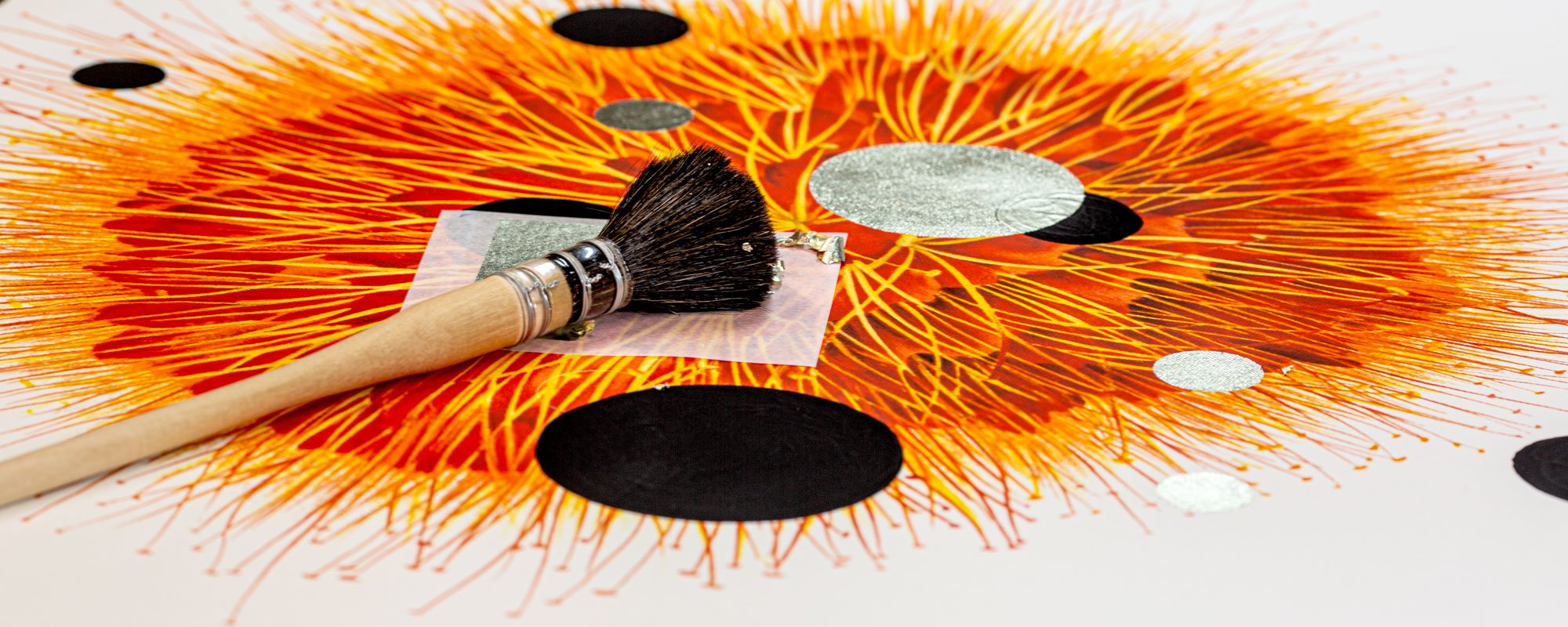
Hand-finished prints can offer a related experience. A piece with, for example, 24-carat gold leaf responds vividly to changing light and alters its character from morning to afternoon. It's not necessarily the right choice in all rooms – in a very bright open-plan office, the reflection might be too active – but placed thoughtfully, it can add a precise, almost ceremonial quality.
Limited editions with numbering and signature also work well for companies that desire art with collector's value but also need a cohesive series. Here, edition logic and personality meet in a format that is both accessible and special.
Scale, placement, and framing change the work
Even the strongest work loses impact if its size doesn't suit the wall. A small print on a large reception wall looks lost. Conversely, a monumental canvas above a low sideboard can feel too intrusive. Start with the wall's actual viewing distance, not just its dimensions. A work viewed from four meters away needs a different visual strength than a work next to a desk.
Ideally, hang art so that the center of the work is at eye level for a standing viewer in common areas. In lounge zones, the placement can be slightly lower, as the works are mainly experienced while sitting. On a gallery wall, the distance between frames is as important as the motifs. Air around the works gives the composition dignity.
The framing should support the art rather than compete with it. Natural wood can add warmth to strict, modern offices. Black or dark-stained wood provides graphic clarity. A light, discreet frame can be the right solution when the paper's texture and the motif's nuances should take center stage. Anti-reflective glass is often a valuable investment in rooms with daylight or strong overhead lighting.
How art creates a cohesive workplace
A successful art plan doesn't mean all walls must be filled. Often, it's more refined to choose a few places where the works have space: arrival, meeting, break, and contemplation. These spaces constitute the small shifts of the workday, and art can make them more conscious.
Let one color, one material, or one artistic method recur throughout the building. This could be the dusty blue tone in several works, a series of paper works in the same format, or a recurring use of gold as a luminous detail. At StoltzeStudio, the interplay between curated compositions, exclusive materials, and the visible presence of the hand is a starting point for art that feels both cohesive and vibrant.
At the same time, avoid using art as mere branding. An office does not become more credible by hanging slogans on the walls or repeating the company's colors in every single work. The value of art often lies in what it gives back: perspective, sensibility, and a space for thought.
The best choice is therefore rarely the most cautious. Choose works that can endure repetition, have material integrity, and make an ordinary workday a little more present. It is a quiet investment in the people who will occupy the space again tomorrow.