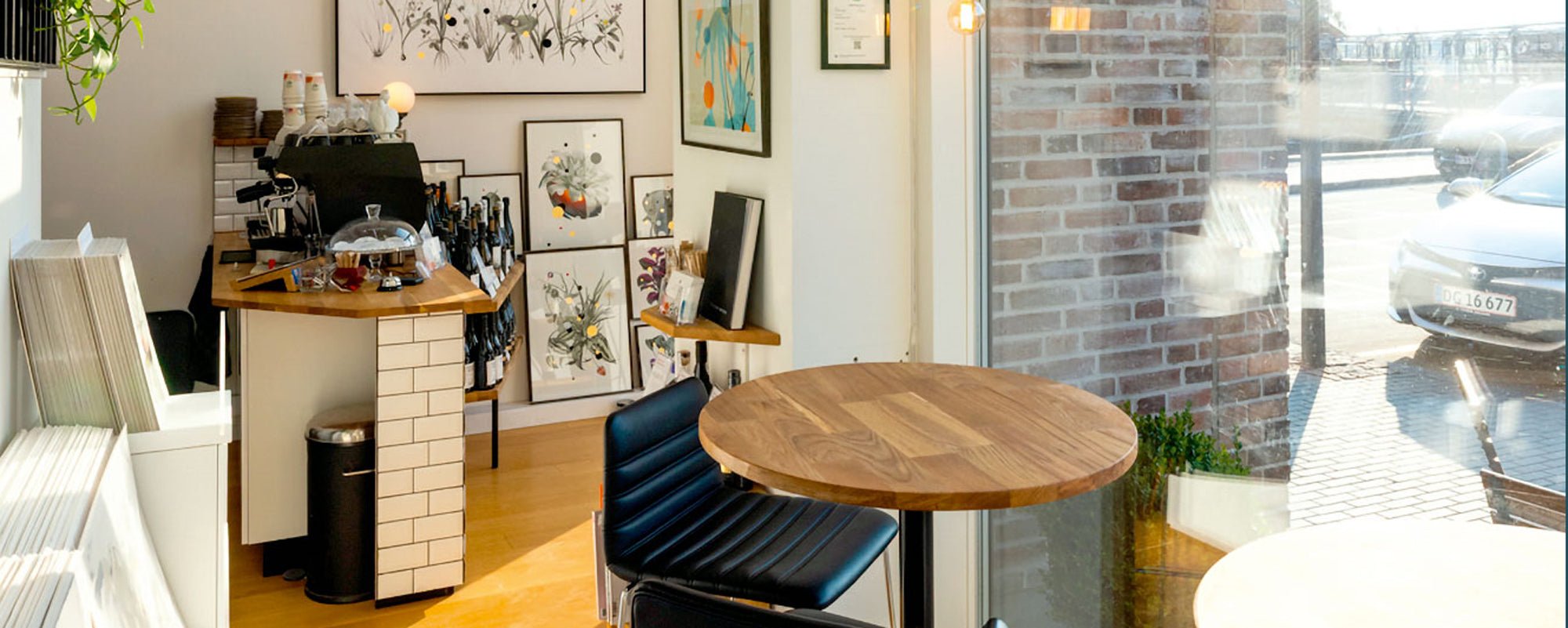
Copenhagen gallery and café with aesthetic depth
There's a significant difference between seeing art and dwelling with it. When you search for "gallery and cafe Copenhagen," it's rarely just to grab an espresso next to some artworks on the wall. It's often a desire for a more holistic experience – a space where atmosphere, materials, light, the gravitas of the artworks, and the tranquility of the coffee all work together in harmony.
Precisely for this reason, these types of places have become so appealing to a design-conscious audience. Not as quick stops on a busy day, but as sensory havens where one can slow down and observe more precisely. When a gallery and a cafe actually function as one coherent entity, something rare emerges: art becomes less distanced, and the cafe experience becomes more refined.
What makes a gallery and cafe in Copenhagen worth seeking out?
The decisive factor is curation. Not just which artworks hang on the walls, but how the entire space is composed. A successful gallery-cafe concept is never a cafe that has randomly hung up some art, nor is it a gallery that has simply put a coffee machine in the corner. The strongest places operate with a clear aesthetic intent, where furniture, colors, surfaces, sound levels, and service all support the visual experience.
For the visitor, this means that quality can be felt before it is explained. The texture of the paper, the profile of the frame, the tone of the wall, and the weight of the cup in one's hand are not peripheral details. They are part of the overall interpretation of the place. This is especially true in Copenhagen, where the audience often has a well-developed eye for design, but also a low tolerance for anything artificial or forced.
A good gallery with a cafe therefore understands the balance between openness and integrity. One should feel welcome without the place feeling diluted. Art should be accessible, but it loses character if everything is reduced to a backdrop for social interaction.
Gallery and Cafe Copenhagen – why so many seek precisely this combination
Art experiences change when given time. In a classic gallery, the atmosphere can be concentrated, but also a bit rushed. You move from work to work, register, evaluate, and move on. A cafe introduces a different pace. It provides a pause, reflection, and the opportunity for a motif to linger a little longer within you.
This is a significant reason why the combination appeals so strongly to adults with an eye for home decor, art, and lifestyle. You don't just come to consume, but to immerse yourself. A good space can inspire everything from a specific art purchase to a new understanding of how a work can live in a private home, an office, or a hospitality environment.
There's also something democratic about the format when it's done with quality. You don't need to enter with pre-conceived references or market jargon. You can start with the coffee, with the light, with curiosity. From there, the relationship with art can grow more naturally.
The aesthetic tension between art and service
The biggest challenge of a gallery-cafe concept is that two cultures must coexist without disturbing each other. Art demands concentration. Cafe operation demands movement, sound, and logistics. If the space is not precisely conceived, the result is often uneven. Either the art feels secondary, or the cafe becomes so restrained that it loses warmth.
The most compelling places solve this through zoning and material awareness. They create rhythm in the space, allowing one to both contemplate and linger. There's a difference between seating that invites quick passage and furnishing that allows for deeper immersion. There's a difference between wall lighting that flatters a print and lighting that makes the work flat. There's a difference between serving coffee as a service and allowing it to be part of the place's identity.
For the public, it's worth noticing these nuances. If the coffee is excellent, but the artworks hang like decorative noise, it's practically a cafe. If the artworks are strong, but the stay feels uninviting or cold, it's practically a gallery with limited hospitality. The rare quality arises when both aspects are taken seriously.
Materials reveal ambition
One can often gauge a place's standard by its material choices. Fine art prints on exclusive paper offer a different depth than standard production. Hand-finished details, canvases with tactile character, and well-chosen frames signal that the artworks are intended as lasting objects, not as seasonal decorations.
The same applies to the cafe side of the experience. Ceramics, textiles, table surfaces, and acoustics tell whether the place has been developed with a sense of longevity. In the most integrated environments, there is no sharp division between the materiality of the art and that of the cafe. Both speak to the same atmosphere of calm, quality, and uncompromisingness.
What to look for as a visitor
If the goal is to find a gallery and cafe in Copenhagen that actually offers more than a pretty facade, one should look for signs of curated coherence. Are the artworks chosen with a clear hand? Is there a common thread in the world of motifs, color palette, or materiality? Does the place feel like a universe or a collection of disconnected decisions?
It's also worth investigating if the artworks are available for purchase, and how they are presented. Places with high integrity often work with editions, signing, format variations, and well-thought-out productions. This creates a more precise relationship between what you see in the space and what you might choose to live with at home.
At the same time, the service should have substance. For an audience considering art purchases, conversation matters greatly. There should be room for questions about technique, paper, pigment, hanging, and lighting conditions. The right guidance is not intrusive. It is qualified, calm, and confident in its perspective.
When the place also shapes your taste
A good gallery-cafe space does more than just display artworks. It teaches you to see. It can sharpen your eye for composition, tone, and proportion. Many only discover in such environments why a work with space around it seems stronger, or why a motif on cotton paper gains a different depth than a glossy standard poster.
This is perhaps the most interesting quality of the format. You don't just leave the place with a good coffee or a potential purchase in mind, but with a fine-tuned aesthetic awareness. For people who decorate with care, this is valuable. Taste rarely develops through hasty decisions. It is formed in encounters with spaces that have been thought through to the very end.
Copenhagen as a setting for the curated pause
Copenhagen has long had a particular sensibility for the combination of culture and everyday life. The city boasts a strong coffee culture, but also a design tradition where function and beauty are not at odds. Therefore, the gallery-cafe format makes particularly good sense here.
However, this does not mean that all places succeed equally well. In a city with many beautiful surfaces, authenticity quickly becomes the decisive difference. Visitors can usually sense whether a place is built on a real artistic practice, or if the aesthetic is primarily intended as a backdrop. This difference is subtle but distinct.
When a place originates from a studio, curation, and a living relationship with the artworks, the stay gains a different weight. There is more precision in the selection, more tranquility in the presentation, and often a more personal conversation around the art. At StoltzeStudio, this very union of gallery, studio, and coffeeshop is conceived as a cohesive brand universe rather than three separate functions. This is an important distinction, because the whole is felt in every detail.
Why the overall experience matters more than trend value
There's a risk that "gallery and cafe" becomes a trend marker. A place you visit because the format looks right from a distance. But the most memorable spaces are rarely those that try to impress quickly. They are those that hold your gaze a little longer because everything is thoughtfully aligned.
For the design-conscious guest, this is precisely where the value lies. Not in volume, not in noise, but in the quality of the experience. A poetic work on the right wall, a well-composed cup of coffee, a table with space for reflection, a conversation with insight. When these elements come together, the visit becomes more than a break in the city. It becomes a subtle shift in attention.
This is perhaps the best way to choose your next gallery-cafe visit: not by how much a place promises, but by how clearly it feels that someone has intended to create a space with genuine artistic integrity. Then the experience is not just beautiful in the moment, but something you carry with you.