How do you properly hang a giclée print?
A giclée print deserves better than a random nail in the wall. When investing in a fine art print on exclusive paper or canvas, hanging is not just about practicality, but about preserving the work's tranquility, depth, and materiality. The question, therefore, is not just how to hang a giclée print, but how to do it with the same care with which the work was created.
How to hang a giclée print without compromise?
The first choice is not the hook, but the placement. A giclée print reacts to its surroundings. Light, humidity, wall color, and furniture proportions affect how the work is perceived – and how well it lasts over time. The most beautiful hanging is often one that feels almost self-evident because the scale, height, and distance are aligned with the room.
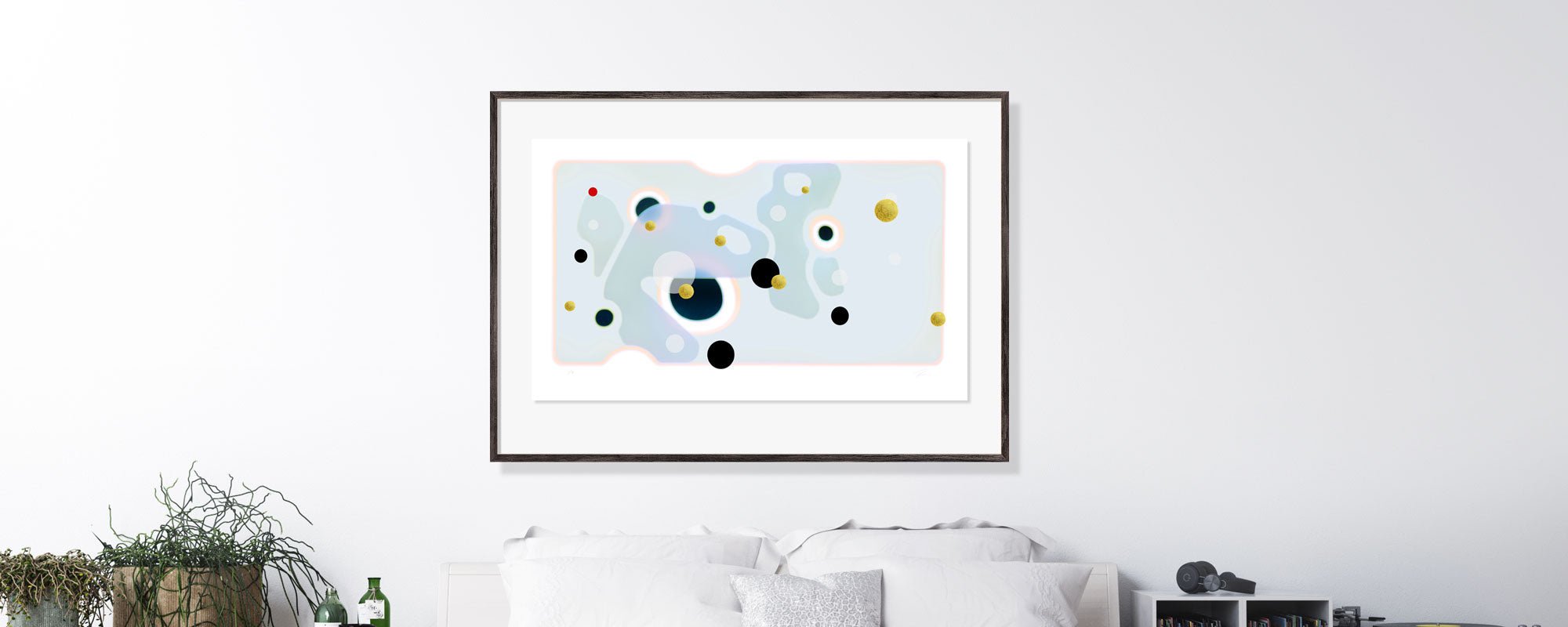
If the print is to hang above a sofa, sideboard, or console, it usually works best when the artwork or frame fills about two-thirds of the furniture's width. If the artwork is smaller, it can quickly look lost. If it's too large, the composition loses its lightness. In a more minimalist room, there should be space around the artwork. The negative space allows the motif to breathe.
Height is the next step. Many hang art too high. A good rule of thumb is that the center of the artwork should be placed approximately at eye level. In private homes, this typically means around 145-155 cm from the floor to the center of the artwork, but it depends on ceiling height, furniture, and the room's feel. Above furniture, there should be a clear, but not too large, distance – often around 15-25 cm is enough to create coherence.
Framing is part of the hanging process
When asking how to hang a giclée print, one should also ask if the artwork is framed correctly. A giclée print on fine art paper should not, as a rule, be hung unprotected with tape, pins, or clips if a lasting and refined expression is desired. The paper is often produced with high archival quality and a surface that deserves protection from dust, UV light, and mechanical wear.
A frame with a mat can give the motif more tranquility and emphasize the artwork's exclusive character. This is especially beautiful for photographic motifs, collages, and paper works with many fine tonalities. A mat creates distance between the print and the glass, which is beneficial for both aesthetics and preservation. For more graphic or intense compositions, a closer framing without a mat might be the right choice. It depends on the artwork's character.
The choice of glass also matters. Standard glass is functional, but reflections can disturb the experience, especially in rooms with large windows. Art glass or UV-protective glass provides a clearer and calmer expression but is more expensive. Here, the classic "it depends" answer applies: If the artwork is a limited edition, signed, or hand-finished, it often makes sense to choose the better solution from the start.
Canvas giclée prints follow a different logic. If the print is stretched on a stretcher frame, it can look strong in some rooms without further framing. The expression becomes more immediate and architectural. But a floating frame can add precision and elevate the artwork from decorative to complete.
Choose hanging method according to wall and weight
The hanging itself must match both the wall type and the weight of the frame. A light frame on a plasterboard wall requires something different from a larger piece on brick or concrete. This is where many mistakes occur – not because the artwork is hung crookedly, but because the wall's nature is underestimated.
On plasterboard walls, brackets or plugs designed for cavities should be used if the artwork has some weight. A regular nail might be sufficient for a very light print, but rarely for professional framing. On brick or concrete walls, one usually needs to drill and use appropriate rawlplugs and screws. This sounds technical, but the result is simple: the artwork hangs stably, close to the wall, and without risk of tilting or loosening.
Preferably use two hanging points for larger frames. This provides better balance and reduces the risk of the artwork becoming crooked over time. Steel wire on the back can be practical, but D-rings or fixed brackets often give a more precise result. The more uncompromising the frame, the more precise the hanging should be.
Light can enhance or destroy the experience
A giclée print is created with great color depth and rich nuances, but direct sunlight is rarely its friend. UV rays can, over time, fade the pigments, even if the print is produced with high quality. Therefore, the artwork should not hang in a place where sharp sunlight hits it for hours every day.
This does not mean that art should be hidden from daylight. On the contrary. Soft, indirect light is often the most beautiful. It allows the paper's texture, black depth, and the materiality of the pigments to emerge without harsh reflections. If the room is very bright, placement on a side wall can be more gentle than directly facing a south-facing window.
Artificial light can be an elegant solution, especially in rooms where the artwork should have prominence in the evening. Choose a light source with good color rendering and not too much heat development. Too warm or bright light can flatten the motif. Too cold light can make the experience clinical. The best lighting is almost imperceptible – it just makes the artwork stand out clearly.
How to hang a single artwork with compositional calm
Once you have chosen placement, height, and hanging method, it's worth spending an extra minute on measurement. Measure the frame's total height and width. Then mark the center of the artwork on the wall with a light pencil mark. If you are working with two brackets on the back of the frame, measure the distance between them accurately and transfer it to the wall using a spirit level.
That small precision makes a big difference. An artwork that hangs a few millimeters crooked can disturb the entire room. In a sensory and well-curated interior, such things are immediately felt, even when one can't quite pinpoint why.
Before you drill, take a few steps back. Look at the relationship to furniture, doorways, and other objects in the room. A giclée print should not just fit on the wall, but integrate into the overall rhythm. Sometimes the right placement is five centimeters lower or slightly further to the left than initially thought.
Gallery wall or solo artwork?
A single artwork can possess an almost meditative strength. Especially larger giclée prints with calm compositions or striking details often benefit from standing alone. This allows for contemplation and lets the material quality speak without disturbance.
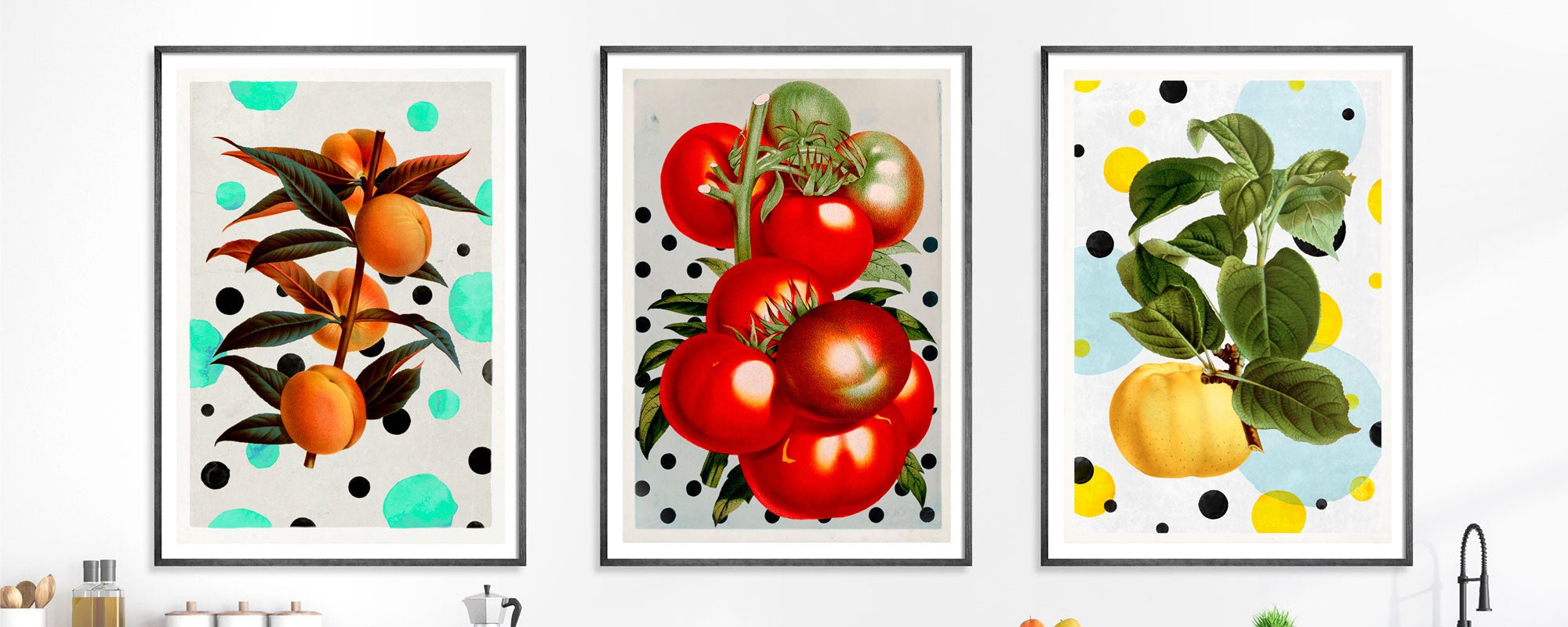
A gallery wall, on the other hand, can create a narrative, pulse, and personality. Here, discipline is more important than many realize. Either there must be a clear common thread in frames, distances, or color scheme, or the variation must be so deliberate that it feels curated rather than random. Giclée prints of different formats can work beautifully together, but they require a clear compositional idea.
If you are working with multiple pieces, lay them out on the floor first. Move them around, adjust distances, and assess the overall effect. An even spacing of about 5-8 cm often works well in a home, but larger pieces may require more air. It's not about rules for the sake of rules, but about allowing each motif its own space within a larger whole.
Rooms with moisture, heat, and movement require consideration
Kitchens, hallways, and bathrooms can be tempting places to hang art because they often have bare walls and a lot of character. But a giclée print on paper does not fare well with high humidity, steam, or significant temperature changes. A bathroom without good ventilation is rarely ideal. A kitchen can work if the artwork is hung away from the stove and direct grease particles.
In the hallway, the challenge is often physical contact. Coats, bags, and hands come close. Here, glass protection and a slightly higher placement can be an advantage. In more trafficked rooms, art should still be able to be experienced, but it may benefit from a little more distance from everyday movements.
When the hanging should feel as complete as the artwork
The best hanging doesn't look forced. It feels precise, calm, and natural, as if the artwork has always belonged there. This is precisely why how to hang a giclée print cannot be reduced to one technique or one bracket. It depends on the paper, the frame, the light, the wall, and the life the room already carries.
At an atelier-based art universe like StoltzeStudio, this idea is fundamental: materials, finish, and placement must work together. A print is not just an image, but a composition in space.