Can art hang in the kitchen? Yes, with care
A kitchen is rarely a quiet room. Here, morning sun, coffee steam, conversations, hot pans, and the small daily rituals that personalize a home converge. Can art hang in the kitchen? Yes – and precisely here, a piece of art can provide the tranquility, depth, and visual awareness that makes a functional space feel like a place you want to linger.
However, kitchen art should not be an afterthought. The space places higher demands on placement, materials, and framing than the hallway or living room. When the choices are right, art can beautifully coexist with daily life without losing its integrity.
Can art hang in the kitchen? The short answer
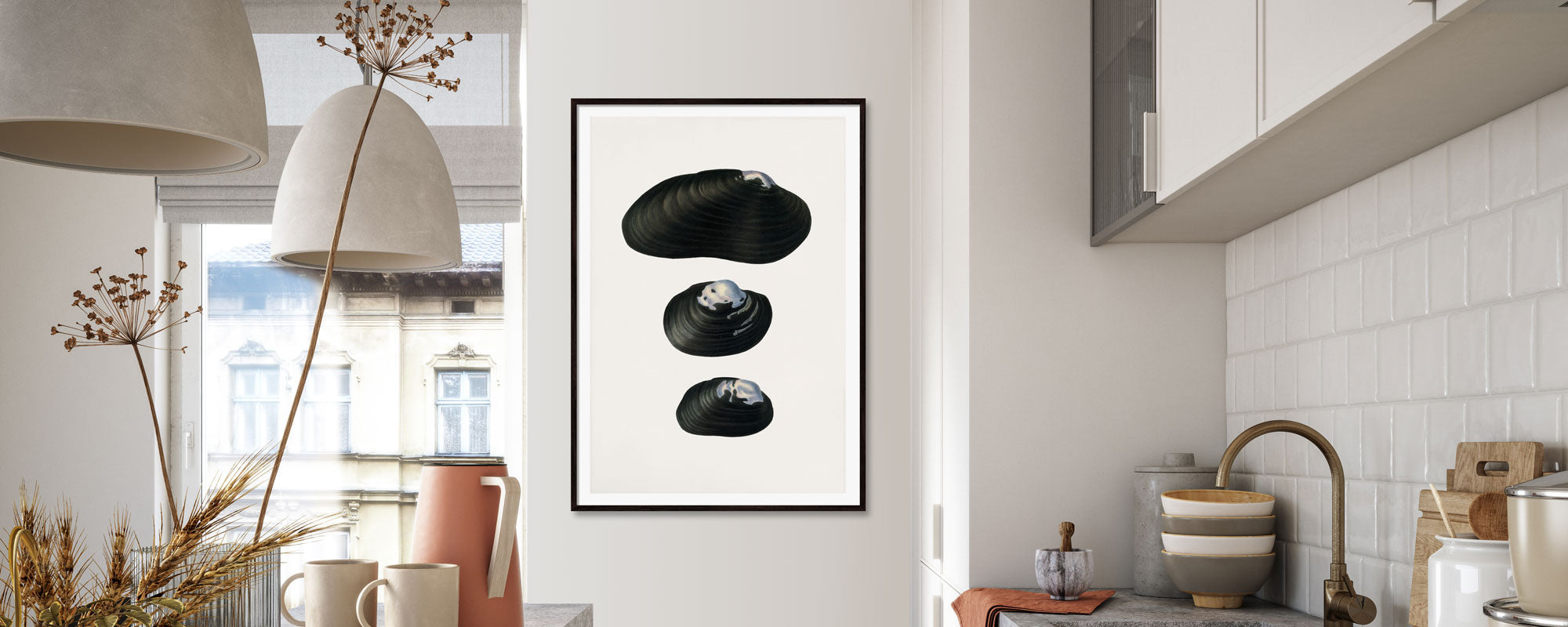
Art is allowed to hang in the kitchen, but it shouldn't hang just anywhere. The crucial factor is not whether the room has an oven or a sink, but how close the artwork comes to steam, grease, direct heat, and repeated splashes. A wall by the dining area, on the opposite side of the kitchen island, or in a quiet niche is often ideal. Here, the art becomes a natural part of the room without being constantly exposed to the kitchen's most demanding zones.
Think of art in the kitchen like a good meal: quality lies in balance. A graphic work can add pulse to a stringent carpenter's kitchen, while a poetic collage or a photographic motif can soften steel, stone, and sharp surfaces. It doesn't necessarily have to match the kitchen's color sample. It should add an excitement that makes the room feel more human.
Distance to heat and water is part of the curation
The most obvious mistake is to place a paper artwork directly above the stove. Here, heat, fumes, and grease accumulate, even when the extractor fan is working. The same applies to the wall directly behind the sink, where water splashes and moisture can, over time, leave marks on both the frame, glass, and artwork.
Instead, choose a location with space around it. As a rule of thumb, art on paper should hang at least 60-90 cm from the stove and sink, preferably further if the kitchen is compact or ventilation is limited. In an open-plan kitchen-diner, there are typically more possibilities: the end wall by the dining table, the wall above a sideboard, or the space between two tall cabinets can accommodate a piece of art with more presence.
Direct sunlight is another factor many overlook. A bright kitchen can be wonderful, but harsh daylight can, over the years, affect colors, especially on delicate materials. Therefore, move the artwork a little away from the most intense window light, or choose framing with UV-protective glass when the placement requires it.
The material determines how relaxed you can be
Not all artworks interact with a kitchen in the same way. Original works on paper, fine art prints, and signed editions require the most consideration because paper reacts to humidity, temperature fluctuations, and touch. This does not mean they should be hidden away. It means the framing must be a real protection - not just a decorative edge.
A Giclée print on exclusive, acid-free paper deserves a frame with a passe-partout or spacer, so the artwork does not lie directly against the glass. The small air gap between the surfaces protects against condensation and simultaneously gives the composition a calm, gallery-worthy depth. Choose UV-protective glass, especially if the artwork hangs in a bright room.
Canvas is often a more relaxed choice in a kitchen because its textile surface adds warmth and tactility. But canvas should still be placed out of the splash zone and not directly over strong heat. An artwork with hand-finished details, such as gold leaf, should be treated with the same respect as any other delicate artwork. The exclusive surface is part of the experience, not a surface that should be able to withstand kitchen spray.
Frames in solid wood, aluminum, or lacquered wood can all work. In very humid rooms, a well-constructed frame with a closed back is an advantage. Avoid cheap materials that warp easily, and avoid cleaning the frame with aggressive products. A dry, soft cloth is usually sufficient.
Choose motif according to the rhythm of the room
The kitchen is a place of energy, but it doesn't have to be visually noisy. The most compelling artwork is often one that creates a conscious contrast to the room's function. In a minimalist kitchen with light surfaces, a dark, saturated composition can tie the room together. In a kitchen with wood, natural stone, and open shelves, a graphic print with clear forms can provide precision and direction.
The motif also doesn't have to be gastronomic. Art with fruit, bottles, and cutlery can be charming, but it's far from the only path. Abstract forms, archive-based collages, botanical motifs, or figurative works can give the kitchen a more personal and less predictable character. Choose what you want to live with, even when there are no guests at the kitchen island.
Colors should be interpreted in relation to the room's existing materials. An artwork can draw a nuance from a marble slab, a brushed brass handle, or a deep tone in the wood, without it becoming perfectly matched. The finest coherence often arises when colors speak softly together, while the motif adds its own voice.
Scale is more important than filling the wall
An artwork that is too small can disappear on a large, empty kitchen wall. Conversely, an artwork that is too large can crowd the space, especially between upper cabinets and countertops. Look at the wall as a surface with its own architecture, not just a hole to be filled.
Above a sideboard or dining table, a single larger artwork often works more powerfully than many small ones. It gives the eye a focal point and allows the artwork to retain its authority. On a narrow wall between cabinets, a vertical format can be the elegant solution, while a series of smaller, related works can create rhythm along a long wall.
As a general rule, hang the center of the artwork at eye level, but let the furniture determine the final placement. Above a sideboard, there should be clear space so that the frame and furniture do not blend together. In a kitchen with bar stools, art can hang a little lower than in a walk-through area, because it is primarily experienced while seated.
Framing makes the difference between decoration and art
A good frame doesn't just protect. It curates the experience. A narrow oak frame can emphasize the warmth and craftsmanship of the paper, while black wood or aluminum creates a sharper, more graphic edge. A passe-partout gives the artwork room to breathe and is particularly beautiful around prints with fine details or hand-finished elements.
Also consider reflections. Kitchens often have many light sources: spotlights, pendant lights, windows, and shiny surfaces. Ordinary glass can make an otherwise strong artwork difficult to see from certain angles. Anti-reflective glass is an investment that makes particular sense if the art is to hang near the dining area, where people spend a long time and experience the artwork again and again.
At StoltzeStudio, materiality is never a supporting role. The weight of the paper, the depth of the print, the signed edition, and the hand-applied finish all contribute to defining the artwork's presence. In the kitchen, precisely this quality becomes noticeable because the room is used so intensely and daily.
When the kitchen is very active
In a home where cooking, baking, and gathering happen every day, it's worth being honest about the strain on the room. If ventilation is weak and there's limited space between walls, sink, and stove, the art can advantageously be moved to the kitchen's dining area or the adjacent living room. This is not a compromise with aesthetics. On the contrary, an artwork just outside the work zone can still set the tone for the entire room, while having better conditions to remain beautiful.
Check the artwork a couple of times a year. Look for dust on the frame, condensation behind the glass, or initial effects from the sun. The best maintenance is simple and regular: gently wipe the frame, keep strong cleaning agents at bay, and ensure good ventilation when the kitchen is in use.
A kitchen should be able to hold more than just function. When art is placed thoughtfully, it doesn't become a fragile guest in the room, but a sensory breathing space in the midst of the day's most vibrant hours.