Development in art and café culture in shared spaces
An espresso on the table can change the way a work of art is perceived. Not because coffee makes art easier to understand, but because the break creates the time that art often demands. The evolution of art and café culture is therefore not just about placing pictures on the walls of a serving area. It's about shaping a place where gaze, conversation, material, and taste are allowed to meet without haste.
For a design-conscious audience, this intertwining has become more significant. People are not just looking for a good print, a precise cappuccino, or an inspiring venue separately. They are seeking a coherence that feels well thought out, right down to the paper quality, the light over the table, and the tranquility that arises when a work of art doesn't have to shout to be noticed.
From Decoration to Curated Presence
Previously, art in cafés was often treated as decorative backdrop: something that could fill an empty wall and add color to the room. This can still have its place, but the more interesting development begins when the artworks become an active part of the venue's identity. Here, there's a difference between hanging pictures and curating a visual narrative.
Curating requires a conscious approach to scale, color temperature, motif world, and rhythm. A large canvas print can give the room weight and an almost architectural focal point. Smaller, numbered fine art prints, on the other hand, can create an intimate sequence that rewards the guest who lingers a little longer. Collage, archival motifs, and graphic compositions can open up layers of memory and visual friction, while hand-finished details in gold leaf capture the light with discreet precision.
Art may well be for sale, but it should first and foremost be worth experiencing. When everything in a room signals purchase, immersion quickly disappears. The strongest art café allows the work to stand with its own integrity and makes acquisition a natural option for the guest who has already established a relationship with it.
Café Culture as a Slow Format
The café is a special space because it requires neither the concentrated silence of a museum nor the quick decision of a shop. People come for a coffee, a meeting, a break from the city, or a few pages in a book. It is precisely this informal occasion that makes the encounter with art more open.
This doesn't mean that café culture should make art harmless. On the contrary, it can provide space for complex works. An abstract motif, a poetic figure, or a darker collage doesn't need a 300-word wall text to resonate. Sometimes it's enough for the work to be in the field of vision while the conversation shifts, the light changes, and the cup empties.
There is a clear quality in this slow format. Art doesn't just become something seen on a planned occasion. It becomes part of everyday life, without losing its special status. For many new art buyers, this is precisely where the threshold is lowered: not by making the work less significant, but by making the encounter more human.
The Evolution of Art and Café Culture Requires a Sense of Material
A room can be beautifully conceived, but it falls apart if the materials do not support the experience. In the encounter between art and café, quality becomes tangible on several levels. The paper of a Giclée print, the depth of the pigment, the frame's profile, the weight of the porcelain, the patina of the wood, and the aroma of freshly ground beans are not isolated details. They are a collective language.
That's also why the premium experience cannot be reduced to a high price or a sterile, neutral interior. It arises from uncompromisingness: that a print is produced on paper that reproduces nuances with calm and depth; that a limited edition is signed and numbered; that an original work bears the traces of hand and process that no reproduction can imitate.
The materiality of the café should speak the same language. A well-thought-out serving supports the artworks, while generic solutions can create noise. It's not about extravagance, but about editorial discipline. Better to have a few elements with character than a room filled with random signals of creativity.
The Physical Space Gains New Value
In an age where art can be discovered on a screen and purchased in minutes, the physical studio has become more valuable, not less. Online, one can assess format, colors, and edition, but one cannot fully feel the surface of the paper or see how gold leaf changes with daylight. Nor can one replicate the special concentration that arises when art is viewed in a space designed for lingering.
A physical art and coffee place therefore functions best as a destination rather than a traditional shop. The guest should be able to come without having decided to buy. This builds trust. The first visit might be a coffee and a glance at the wall. Next time, it might be a conversation about a specific motif, the size for an entryway, or the difference between an open and a numbered edition.
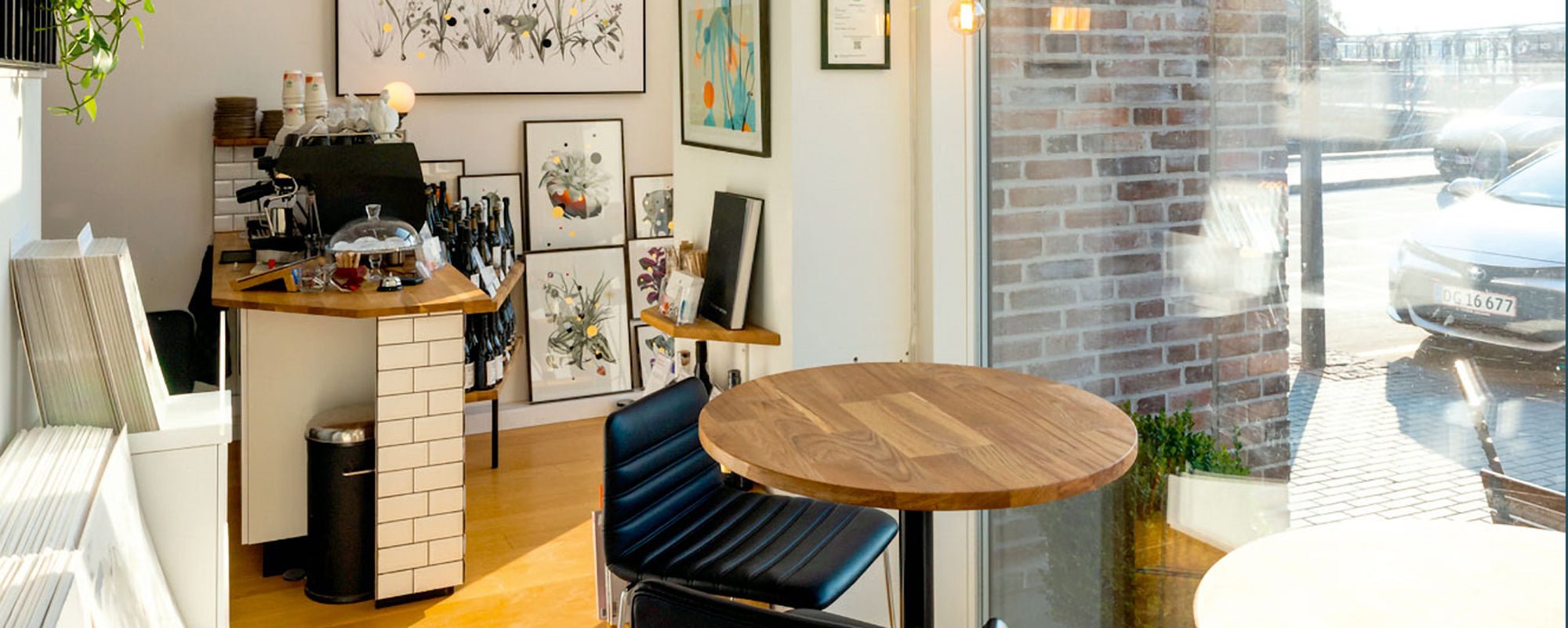
At Sluseholmen in Copenhagen, StoltzeStudio is an example of this close connection between atelier, gallery, and coffeeshop. Here, the curated atmosphere is not an addition to the art, but a framework that allows materials, works, and encounters to be treated with the same seriousness.
When Art Doesn't Become a Prop
The connection between café and art also carries a risk. Art can quickly end up as a photo-friendly background, chosen to work for a brief moment on social media. Such spaces can be visually effective, but they often age quickly because they are built on recognizability rather than genuine taste.
The alternative is not to reject the visual or the shareable. A strong space should indeed be photographed. But it should have something to say, even when the camera is gone. This requires courage to choose works that don't need to please everyone, and to let a more subdued palette or a demanding motif set the tone.
Naturally, it depends on the ambition of the venue. A busy morning bar has different needs than a studio where guests come to linger. But regardless of the format, art should have a function beyond confirming a trend. It should add perspective, atmosphere, or a real point of stillness.
A More Personal Art Market
This development also points to a change in the way people buy art. Many no longer decorate solely according to a specific style. They collect works that create balance, memories, or contrast in a home, an office, or a hospitality environment. A work must be able to live with the architecture, but also with the person who sees it every day.
Here, the café and studio space have a particular strength. They display art in usable proportions and in a living environment. A print is not seen as an isolated product image, but as part of a room with light, furniture, and human movement. This helps the buyer understand what the work can do in their own environment.
Good advice is therefore not a quick recommendation of the largest format or the most popular color. It is based on the wall, the room, the distance to the work, and the atmosphere the buyer wishes to create. Some homes call for a single striking work. Others gain more depth from a smaller series, where motifs and formats are allowed to conduct a quiet conversation.
Places You Return To
The most interesting art cafés are not measured by how many impressions they can cram into one square meter. They are measured by whether they make the guest want to return. Perhaps to see the same work in a different light. Perhaps to discover a new detail in a composition. Perhaps simply to sit somewhere where quality is tangible without being demonstrative.
For those who choose art for their own space, the café experience can be a good question to take home: Which work makes me want to slow down? The answer often points to the art that continues to have something to say.