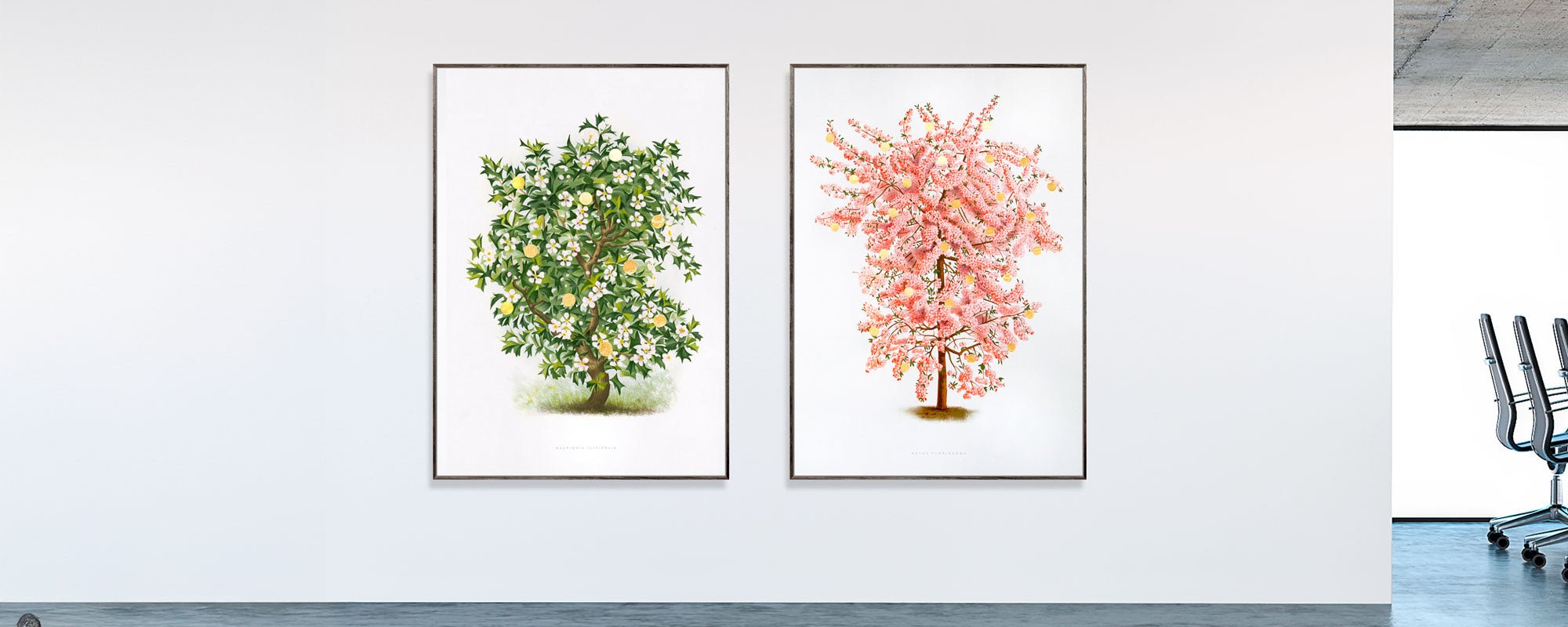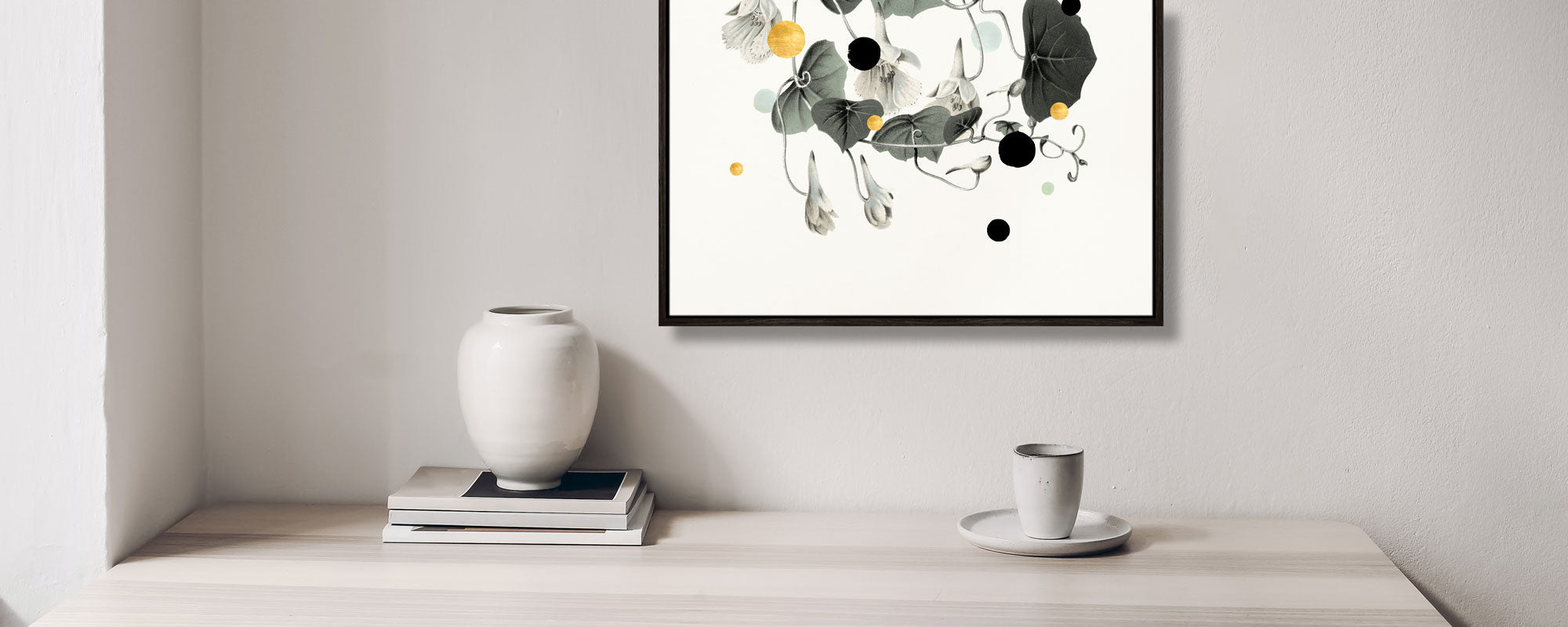
Art for the home office versus living room in harmony
A piece of art above a desk should be able to keep your gaze awake without demanding all your attention. A piece in the living room should be able to spark conversation, change the mood at dusk, and continue to reveal new facets. Therefore, art for a home office versus a living room is not just about finding two motifs that fit two walls. It's about understanding what the rooms need to be for you.
The home office is a space for concentration, decisions, and long breaks with eyes fixed on the screen. The living room is more ambiguous. This is where the day ends, guests gather, and quiet hours are allowed to unfold. Art does not necessarily have to be subdued in the office and dramatic in the living room, but its role should be deliberate. When art, space, and rhythm meet, the interior becomes more than decorative. It gains its own pulse.
Art for the home office versus the living room: two different tasks
In the home office, art's finest quality is often its ability to create mental distance. It can give the eye a rest from text, meetings, and notifications without distracting the mind. Therefore, choose a piece with a clear composition, a defined color palette, or a poetic detail that rewards a calm gaze. Abstract forms, reworked archival motifs, and collages with clear rhythm work particularly well because they don't lock the room into one narrative.
The living room can accommodate a greater range. Here, a motif with more weight can be the focal point around which the furniture is oriented. A striking figurative work, a complex collage, or a canvas with tactile layers can create depth in a room where you spend a long time and view it from multiple distances. The art should not just work when the room is tidy and the sun is shining in. It should also have a presence in lamplight, in company, and in the late hours when the living room becomes a sensory refuge.
The difference lies less in the category of the motif than in its energy. An intense work can certainly function in an office if the rest of the room is simple and calm. Conversely, a quiet, almost monochrome composition can become the living room's most refined focal point if it is given a generous wall around it.
Start with the wall, not with the color
Many people choose art by first looking for a color that matches the sofa or office chair. This can create harmony, but it can also make the artwork an accessory. Instead, start with the wall's proportions, the direction of daylight, and the distance from which the artwork will be viewed.
Above a desk, one often sits close to the artwork. Here, the surface of the paper, the graphic precision, and the small shifts in a handcrafted detail can be felt. A medium-sized fine art print can therefore have more presence than an oversized format. Allow at least a little wall to be visible around the frame. The negative space gives both the artwork and your thoughts room to breathe.
In the living room, art is often viewed across the room. A too-small piece above a wide sofa disappears, no matter how beautiful the motif. Choose either a larger format or create a deliberate group where the pieces share a color tone, edge, or visual tension. The crucial factor is not mathematical symmetry, but a sense of weight. The size of the artwork must be able to stand up to the volume of the sofa, the texture of the rug, and the open surfaces of the room.
Light changes the character of the work
A home office with direct daylight places different demands than a living room with low lamps and shifting shadows. Paper-based giclée prints can appear precise and vibrant in soft, indirect light, while canvas offers a more physical depth and often reads strongly from a distance. If the work has gold leaf or other reflective details, its placement should be chosen carefully. The same shimmering surface can be a subtle reward at the desk, but become restless if constantly hit by bright light.
Look at the wall at different times of the day before deciding. A piece of art is not just bought for a dinner party or a ten o'clock workday. It must live with the room through all its moods.
Home office art should provide direction
Office art doesn't have to be neutral. On the contrary, a personal piece can help make the workspace a place you actually want to return to. But there is a difference between inspiration and visual clutter.
Feel free to choose compositions with a clear movement, but avoid too many competing focal points directly in your line of sight. If the artwork is directly above the screen, a calmer motif may be best. If it hangs on the side wall, it can be more complex, because the gaze itself chooses the break. A work with deep blues, earthy reds, or muted green tones can give the room stability, while a clear accent color creates a well-placed energy in an otherwise subdued setup.
The frame is not an afterthought. A slim wooden frame brings warmth to a workspace with metal, glass, and technology. A black or dark frame can tie together a more graphic interior and give the motif sharpness. A passe-partout adds calm and distance, especially around works with fine lines or delicate color work.
If you only have one wall, it is often stronger to choose one work with sufficient character rather than several small motifs. The home office should feel curated. It is a space where focus is a luxury.
The living room can feature a substantial piece of art
In the living room, art can take up space in a different way. It can be the element that cannot be explained solely by color scheme or trend. An original work or a numbered limited edition print adds a special awareness: here hangs something chosen for its own sake.
Above the sofa, it is tempting to center everything precisely. This is often correct, but not always. An asymmetrical placement can be more vibrant if balanced by a floor lamp, a sculptural chair, or a tall plant. However, this requires the artwork to still have a clear relationship to the furniture. Do not let it float up towards the ceiling. The art should speak with the seating area, not hover above it.
The living room also tolerates contrast. A light, minimalist interior can gain more character from a dark, saturated motif. In a home with many tactile materials such as wool, wood, and ceramics, a sharp graphic print can create precision. If the room already contains many colors and finds, a more refined work can, on the other hand, function as silence between elements.
It is not necessary for the art to repeat pillows, curtains, or rugs. It can introduce a tone that otherwise only exists in a small detail. Precisely this repetition, almost unconsciously, makes a room feel cohesive without becoming predictable.
One language across, not identical art in all rooms
When both the office and living room need furnishing, the desire for a common thread often arises. This doesn't mean both rooms should have the same motif or identical frames. It's more interesting to create kinship through materiality, color scheme, or artistic method.
For example, you can let a refined art print on exclusive paper give the office its precision, while a larger canvas from the same visual universe adds texture to the living room. Or choose two works that share a specific shade of blue but have widely different compositions. At StoltzeStudio, the interplay between curated editions, tactile finish details, and poetic compositions is precisely a way to create this connection without making the home uniform.
A hand-finished gold surface can be repeated as a subtle impulse from room to room, while the pace of the motifs varies. In this way, the home does not become an exhibition of matching products, but a unified narrative with several chapters.
Give the artwork the distance it deserves
Art works best when it is allowed to be art and not just fill an empty space. Therefore, don't automatically hang something up just because the wall is available. Instead, ask what the room needs: concentration, warmth, depth, a break, or a counterpoint.
In the home office, the right piece of art can make the workday more human. In the living room, it can become a quiet anchor that unifies the space without dominating it. Choose with your eyes, but also with your body: The best artwork is often the one you continue to discover long after it has been hung on the wall.