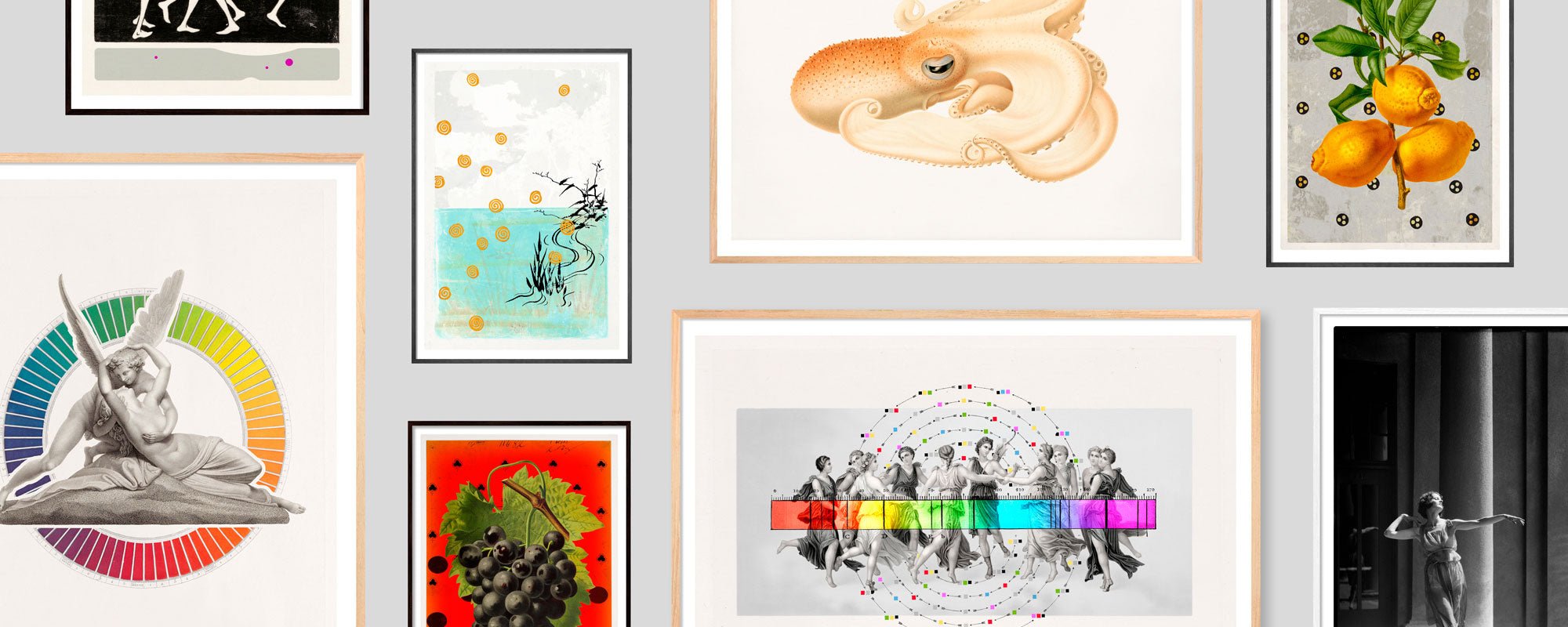
Art posters with collage for modern spaces
A room can be beautifully furnished and still feel incomplete. Often, it's not a lack of more objects, but a work with presence – something that ties the atmosphere together, creates rhythm, and gives the eye a place to rest. Here, art posters with collage have a particular strength. They bring layers, texture, and visual intelligence into the decor without appearing heavy or over-explained.
Collage is inherently composite, but the best works never feel random. They feel precise. A fragment of archival material, a muted color field, a section with patina, or a graphic break can together create a poetic composition where tension and tranquility coexist. This is precisely why collage posters appeal so strongly to design-conscious homes and professional environments, where aesthetics can be personal, but never noisy.
Why art posters with collage feel more alive
A collage works with multiple times at once. It can bear traces of something found, something refined, and something newly composed. It is therefore not perceived as a flat decoration, but as a work with inner movement. This gives the wall character, even when the color palette is calm.
For the quality-conscious buyer, the appeal often lies in this tension between the controlled and the intuitive. A good collage is curated with a steady hand, but it retains a touch of the unpredictable. This makes it more human to live with. Where a purely graphic print can feel sharp and complete, the collage form can open up the space and invite repeated glances.
It is also an art form that suits modern interiors unusually well. Minimalist rooms need works with materiality, otherwise the whole can easily become too cool. More classic rooms, on the other hand, benefit from the collage work's breaks and lightness, which can loosen up the formal expression. The collage is therefore remarkably flexible, but not neutral. It always adds a point of view.
What characterizes a successful collage poster
Not all collage works function equally strongly as poster art. The format places demands on balance, detail, and material sensibility. When it succeeds, it is rarely due to chance.
First and foremost, composition is crucial. A successful collage poster has a clear field of tension between surfaces, shapes, and pauses. There must be something to discover, but also something to settle into. Too many elements create unrest. Too few make the work decorative in an empty way. The right balance feels almost architectural.
Colors play an equally central role. In premium interiors, it is often the subdued shades, the limewashed tones, the deep earth colors, and the dusty contrasts that last longest. This does not mean that collage art should be colorless. On the contrary. But the colors must be orchestrated, not shouted. A single warm accent can have a greater effect than an entire spectrum if the rest of the work is built with discipline.
Finally, reproduction quality is absolutely essential. Collage is an art form where texture, paper grain, shadows, and transitions mean a lot. If the print is flat or the paper too simple, the work loses its depth. Therefore, print technique and material selection should be considered with the same care as the motif itself. Giclée on exclusive paper provides a different weight and tonality than standard production, especially when the work is based on fine surfaces and subtle layers.
Art posters with collage in different rooms
In the living room, collage posters often work best when given space around them. They don't necessarily need a large wall, but they benefit from air. A work with layers and texture must be able to breathe, otherwise it loses its authority. Above a sofa, a sideboard, or in dialogue with a single piece of furniture, the poetic composition of the collage can become the element that elevates the entire room from neat to complete.
In the bedroom, collage is particularly interesting because the medium can be sensual without being sentimental. Here, softer contrasts, more muted fragments, and organic forms work well. The work should have depth, but it should not impose itself. A bedroom often requires art that can whisper rather than insist.
In the home office or creative workspaces, collage art can add intellectual energy. It recalls process, selection, and transformation – qualities that many designers, writers, and visual professionals intuitively respond to. But here too, there's a caveat: If the motif is too complex or color-saturated, it can distract. It depends on the function of the room and whether the art should activate or balance.
In hospitality environments, receptions, or meeting rooms, collage posters have a special advantage. They signal taste and curation rather than generic wall decor. This makes a difference when a room needs to feel well thought out. Guests don't necessarily analyze the work, but they notice when it has been chosen with integrity.
How to choose the right work
The most obvious starting point is not the color of the sofa, but the atmosphere the room lacks. Does it need more warmth, more direction, more tranquility, or a more distinct identity? Art should not just match. It should correct, refine, or enhance.
If the room already has many materials – wood, textiles, glass, books, ceramics – a simpler collage with few, precise layers may be the strongest choice. If, on the other hand, the interior is stark and monochrome, a work with clear texture and archival character can provide the necessary depth. It's about the relationship between the work and its surroundings, not isolated beauty.
The format is also crucial. Many choose too small, especially when buying art posters online. A collage easily loses its effect if details and rhythm are compressed into a format where the eye cannot read the work from a distance. Conversely, a very large format may require a simpler composition so as not to dominate the room too strongly. Here, it is worth thinking in proportions rather than standard measurements alone.
The frame should support the work, not compete with it. Oak, black wood, and light profiles are often safe choices, but it depends on the character of the collage. A work with architectural precision can carry a sharp, dark frame. A more poetic and tactile composition often calls for something lighter. A mat can provide calm, but at the same time removes the work a little from the viewer. It's a question of desired distance and atmosphere.
When finish and edition make the difference
In the premium segment, the experience does not stop with the motif. Materiality, finish, and edition logic help define the work's value – both aesthetically and emotionally. A collage poster printed with depth, precision, and respect for the original's surfaces gains a completely different presence on the wall.
This is especially true when the work is produced as fine art print with carefully selected paper and pigment-based printing. Here, black becomes more velvety, colors more nuanced, and the small transitions between layers appear sharper. If, in addition, handmade details or limited editions are incorporated, the work moves from decorative poster to small-scale collector's item.
This difference is not only for the experienced art buyer. It is also felt by those who simply want something better. Something with more substance. StoltzeStudio works precisely in this tension between curated poster art and atelier-anchored quality, where materials and finish are not an afterthought, but part of the work's identity.
Collage as a counterpoint to the mass-produced
There is a lot of wall art that is designed not to disturb. This is often precisely the problem. It blends in, but it doesn't stick in the consciousness. Collage art can do something different because it is based on selection, contrast, and transformation. It has an inner life.
For the design-conscious buyer, this is essential. One does not necessarily want a work that takes over the room, but one also does not want something anonymous. Art posters with collage are precisely in this field. They can be elegant and understated, but still have an edge. They can create calm without becoming neutral.
Precisely for this reason, they also last better over time. Not because they are trend-proof in the classic sense, but because they contain multiple layers. You see something new in them when the light changes, when the room is rearranged, or when your own gaze changes. It is a quiet quality, but a rare one.
The best work is rarely the one that explains itself immediately. It is the one that keeps opening up a little, every time you pass it.