Curated art prints for an office with character
An office quickly reveals what a company believes in. Not in the presentation on the screen, but in the walls, the light, and the images one chooses to live with every day. Curated art prints for the office are therefore not mere peripheral decoration. They are a quiet yet precise marker of culture, ambition, and taste.
There is a noticeable difference between art that simply fills an empty space and art that brings a room together. In a work environment, that difference becomes even more apparent. Here, the works must be able to withstand repetition – morning meetings, concentration, breaks, late hours – without being noisy, becoming flat, or losing their excitement. This requires curation. And it requires quality.
Why curated art prints for the office work
An office is rarely just a workplace. It is also a public face, an environment for collaboration, and a space that influences pace, focus, and well-being. When art is curated, it becomes part of the architectural whole rather than an afterthought. Colors communicate with materials. Formats respect the scale of the room. Motifs add atmosphere without stealing all attention.
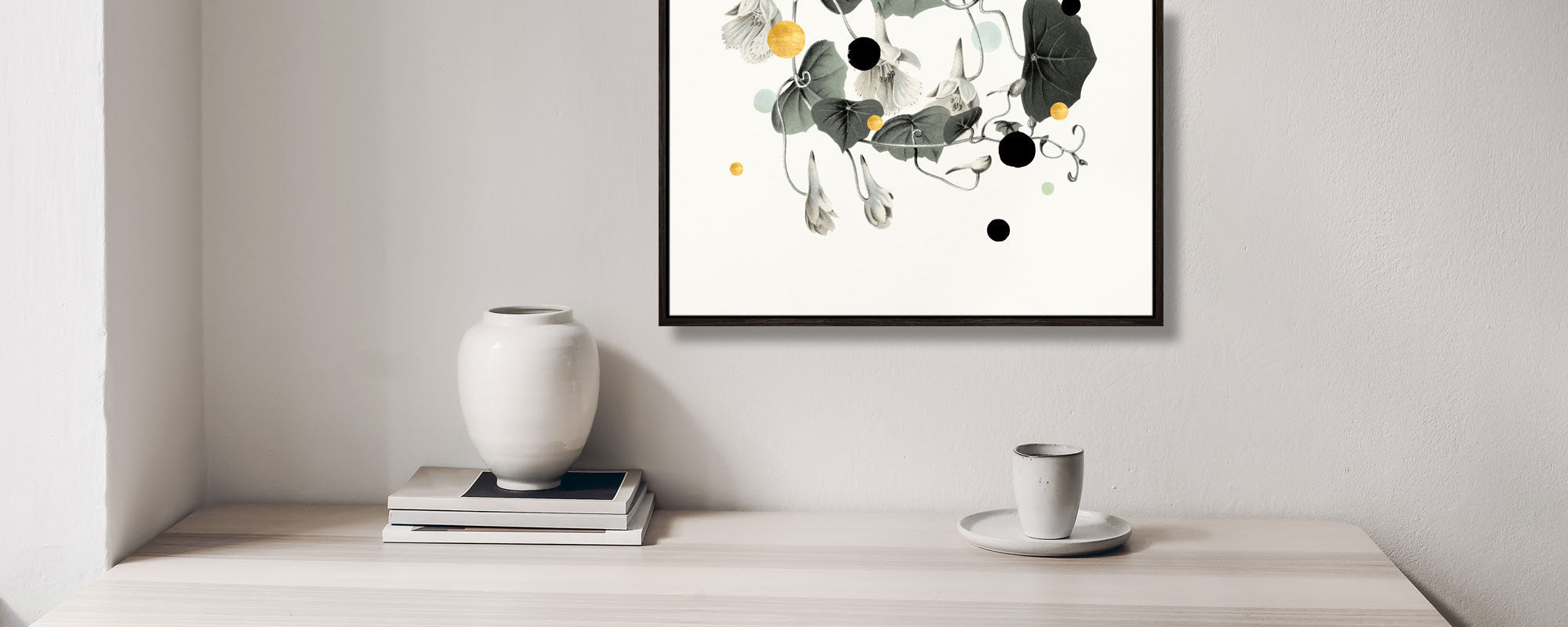
This is precisely where curated art prints differ from generic wall decoration. Curation is not about choosing the most striking work, but the most precise. A poetic collage print can create depth in a meeting room where many voices need calm. A graphic work with a tight composition can provide direction in a reception area. A more tactile print on canvas can soften an office with glass, metal, and hard lines.
When the choice is well-considered, a special kind of visual discipline emerges. The space feels more cohesive, but also more human. It is an understated luxury, often felt before it is explained.
What good office art should achieve
Art for the home can be private, unpredictable, and entirely unique. Art for the office can be personal, but it must also function in a shared space. This doesn't mean it has to be neutral or innocuous. It means it must have balance.
The best works for workspaces often possess a kind of inner calm. Not necessarily in the motif, but in the composition. The eye should be able to return to the work again and again without becoming tired. Layers, texture, archival traces, muted contrasts, and deliberate color fields often provide more long-term value than motifs that try to impress at first glance.
At the same time, materiality should be taken seriously. A Giclée print on exclusive paper has a depth and precision that ordinary poster printing rarely matches. The nuances appear clearer, dark tones gain more weight, and the surface retains the integrity of the work. In a professional environment where detail matters, this is visible.
How to choose art for different office spaces
There isn't one right expression for all workplaces. A law firm, a design studio, and a boutique hotel with work zones will naturally call for different atmospheres. Nevertheless, there are some principles that make the choice sharper.
The reception area requires presence
The reception is the first encounter with the place. Here, art should have character, but also dignity. Works that are too small easily disappear, while too many motifs can create visual clutter. One striking print or a tightly curated series often provides more gravitas than a random picture wall.
Prefer works with clear composition and tactile quality. The reception area can tolerate a bit more drama than the rest of the office because it is meant to set the tone.
Meeting rooms need concentration
In meeting rooms, art helps regulate energy. If the works are too insistent, the room loses focus. If they are too anonymous, they add nothing. Poetic compositions, muted palettes, and motifs with depth work particularly well here. They create a sensory breathing space without dominating the conversation.
Large formats can be powerful in meeting rooms, but only if the motif has space. Tightly composed large-scale works can quickly feel heavy in smaller rooms.
Work zones should be quiet
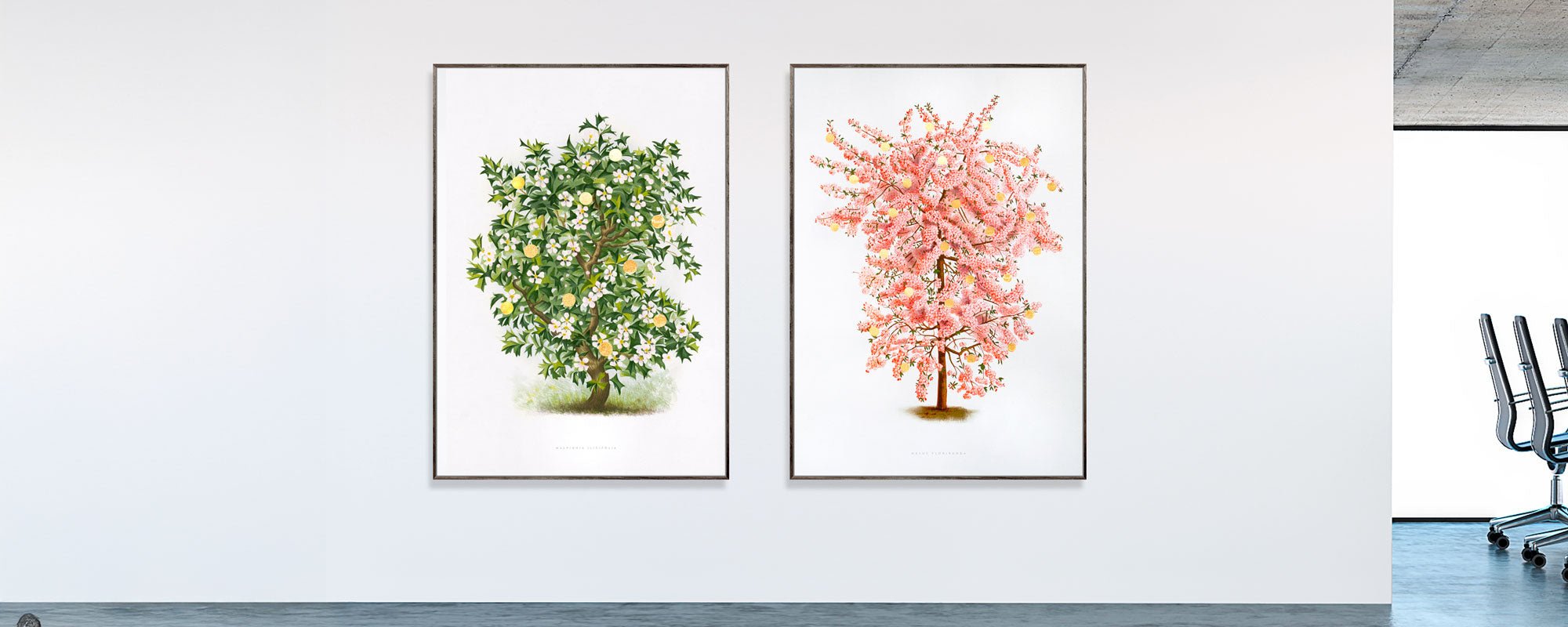
In open office environments and individual work zones, art should support rhythm rather than interruption. Series with related tones and motifs can link larger areas and create a sense of cohesion. Here, it is often better to think in terms of repetition, variation, and curated flow than in individual statement pieces.
The executive office can bear more personality
In more private rooms, there is space for greater distinctiveness. Here, limited editions, hand-finished details, or more striking works can work particularly well. This adds weight, but also narrative. Art in this context signals not just taste, but decisiveness and an eye for the original.
Format, materials, and finish make the difference
Many underestimate how much format matters. A beautiful work in the wrong size loses its power. Prints that are too small on large walls often seem timid. Works that are too large in compact rooms can become dominating. The right scale creates calm because the eye perceives that the proportions are correct.
Materials are equally crucial. Fine art paper provides sharpness, subtlety, and a refined surface, which is particularly suitable for graphic motifs, collage, and detailed works. Canvas adds softer weight and a more painterly presence, which can be ideal in hospitality-inspired office environments or rooms that need to feel warm and inviting.
Finish is what elevates a print from nice to memorable. Hand-finished elements, such as gold leaf or other tactile details, add a discreet luxury that doesn't shout but keeps giving. The same applies to limited editions with signatures and numbering. In an office, such choices set a clear standard. They communicate that the art is not bought as filler, but chosen as value.
Curation is also about brand identity
For companies with a strong visual profile, art is an extension of the brand's language. Not in the literal way where colors merely match the logo, but on a more sophisticated level. Is the brand characterized by clarity and precision, or by warmth and tactility? Should the rooms communicate discreet authority or creative openness?
Curated art prints for the office can support both if the choice is deliberate. A minimalist environment often benefits from works with texture, archival traces, or organic breaks, as they add humanity. Conversely, a more sensory interior can benefit from graphic compositions that create resilience and structure.
This is also where many go wrong. They choose art based solely on personal taste or on the idea of what looks expensive. But good office art is about relationships – between work and wall, between color and light, between company and visitor.
When price and quality are not the same as decoration and budget
There is always a budget question. But in practice, the cheapest solution is rarely the one that lasts longest – neither visually nor strategically. Mass-produced prints can fill space, but they rarely create lasting identity. They often become invisible quickly, and then the purpose is already lost.
This doesn't mean that all offices need to invest in original collector-level works. Fine art prints are precisely interesting because they can provide artistic quality, material integrity, and curated distinctiveness within a more flexible framework. Especially when produced with uncompromising quality and clear edition logic.
A well-chosen print can carry a room for years. It is more than decoration. It is part of the atmosphere, and atmosphere has real value – for employees, guests, and the way a place is remembered.
The quiet luxury of a thoughtful choice
There is something special about offices where the art doesn't feel inserted, but integrated. You feel it in the overall impression. The walls don't feel empty, but neither are they over-furnished. The rooms gain depth without losing their function. This is often the result of fewer, better choices.
For design-conscious companies and creative professionals, it makes sense to consider art from the outset or to use it as a precise tool in upgrading existing spaces. An atelier-rooted art and design studio like StoltzeStudio understands precisely this balance between work, material, and spatial atmosphere that makes the difference between decoration and true curation.
The best place to start is therefore not with the question of which pictures are pretty. Start by looking at the rhythm of the room, the character of the light, and the atmosphere the place deserves to have. When art is chosen with the same uncompromising quality as furniture, materials, and architecture, the office doesn't just become more beautiful. It becomes more precise, more memorable, and far more pleasant to be in.